Climate science
Global Carbon Budget 2025: the key findings, explained
The Global Carbon Project’s annual report is the reference count of the world’s CO₂. Here is what the 2025 edition found, what the numbers mean and how it compares with other estimates.
The Global Carbon Budget 2025 in brief
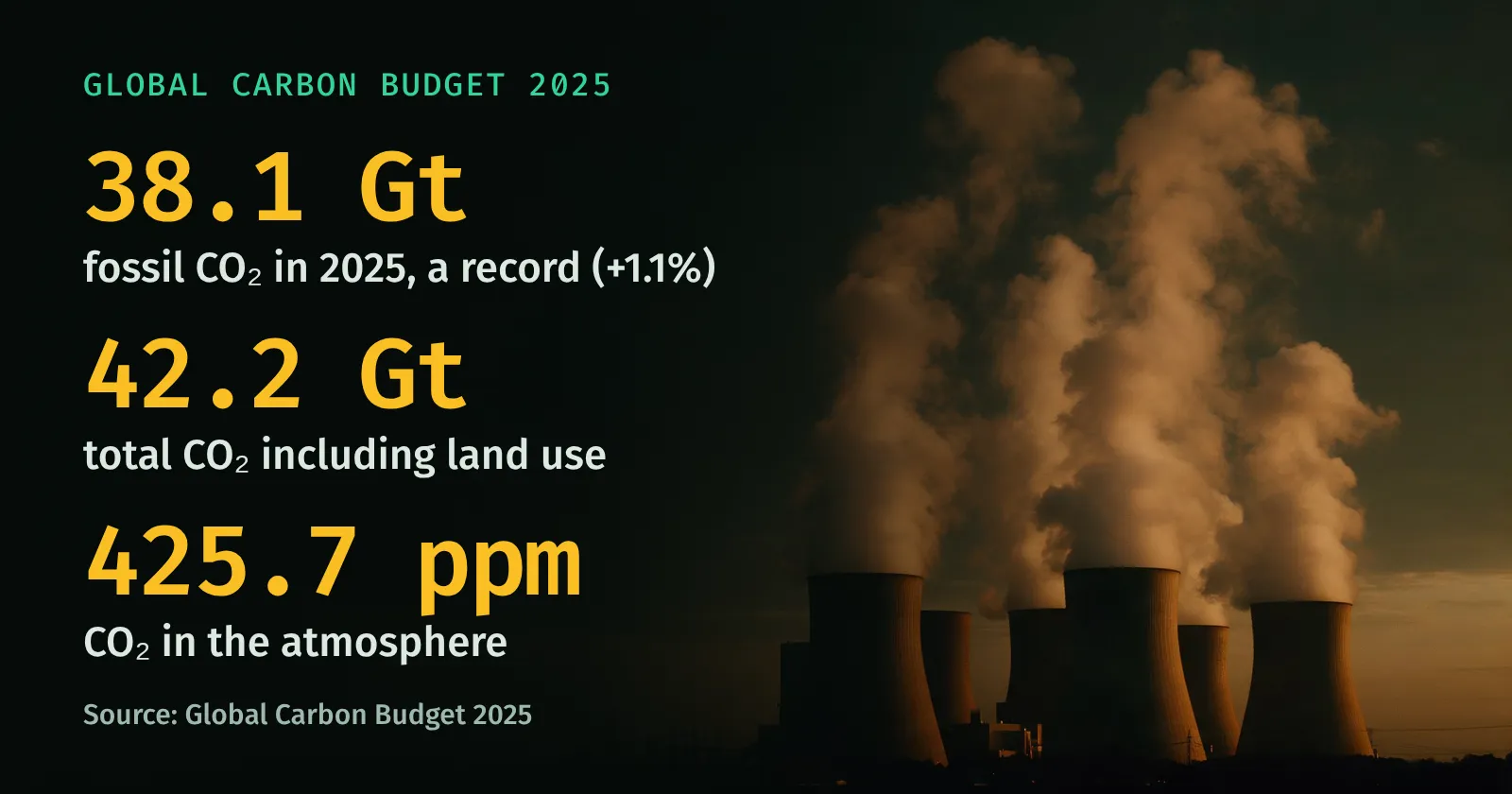
The Global Carbon Budget 2025 found that fossil CO₂ emissions reached a projected record of 38.1 billion tonnes (Gt) in 2025, up 1.1% on 2024. Emissions from land-use change, mainly deforestation, fell to about 4.1 Gt, so total CO₂ emissions were 42.2 Gt, slightly below the previous year.
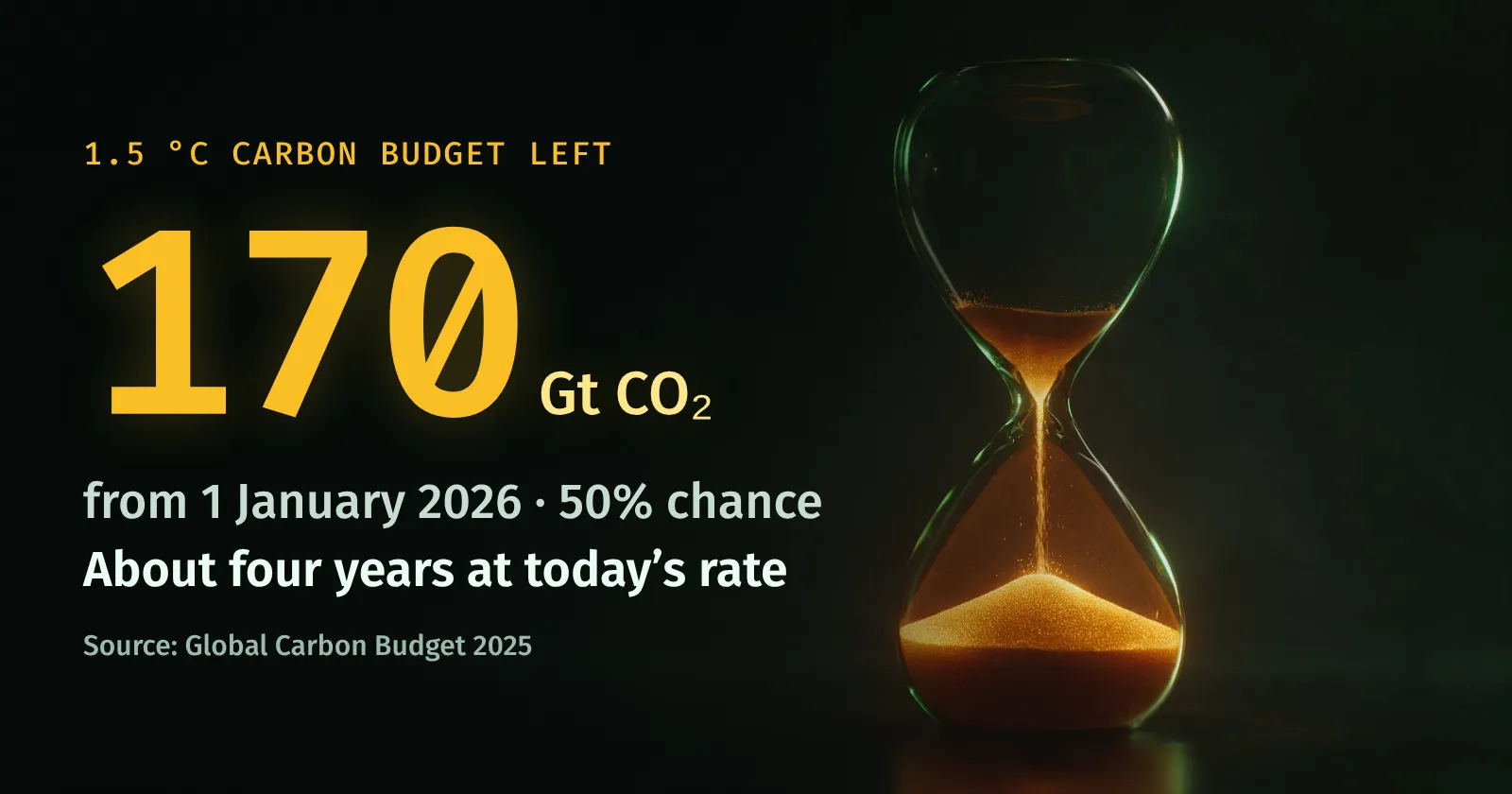
The report also concludes that the remaining carbon budget for 1.5 °C is nearly used up: about 170 Gt CO₂ from 1 January 2026 for a 50% chance, or roughly four years at the 2025 rate. Atmospheric CO₂ was projected to average 425.7 parts per million (ppm) in 2025, 52% above pre-industrial levels.
The Global Carbon Budget is produced each year by the Global Carbon Project, a team of more than 100 scientists. The 2025 edition was launched at COP30 in Belém in November 2025 and published as a peer-reviewed paper in Earth System Science Data in 2026. Figures for 2025 are projections based on data for most of the year, so they can be revised slightly in later editions.
How much CO₂ did the world emit in 2025?
Fossil emissions rose for every major fuel. The report projects coal up about 0.8%, oil up 1.0% and natural gas up 1.3%. International aviation grew fastest, at about 6.8%, as air travel kept expanding.
Land-use change emissions moved the other way. They were projected to fall by almost 10% to 4.1 Gt, largely because deforestation and forest fires in South America were unusually low. The authors stress that confidence in this land-use figure is low: it is the hardest part of the budget to measure.
Put together, humanity released about 42.2 Gt of CO₂ in 2025. That is roughly 1,338 tonnes every second, the rate shown on our live CO₂ counter.
Which countries’ emissions rose or fell in 2025?
The four largest emitters all saw their projected fossil CO₂ rise in 2025, but at very different speeds. China, which produced 31.8% of global fossil CO₂ in 2024 (12.3 Gt), grew only 0.4%, much slower than its trend of the past decade. The US produced 12.7% and India 8.3%.
| Country or region | Projected change in fossil CO₂, 2025 |
|---|---|
| China | +0.4% |
| United States | +1.9% |
| India | +1.4% |
| European Union | +0.4% |
| Japan | −2.2% |
| Rest of the world | +1.1% |
| World | +1.1% |
- China: growth slowed sharply as record solar and wind additions met most of the rise in electricity demand.
- United States: a cold winter and higher energy demand lifted emissions.
- India: growth was below recent years, partly because milder weather held down demand for coal power.
- EU and Japan: the EU was roughly flat to slightly up; Japan, reported separately for the first time, continued its decline.
The peer-reviewed version published in 2026 adjusted some of these country projections (for example a somewhat larger rise for the US and roughly flat EU emissions), but the overall picture did not change. The report also found that at least 35 countries have cut fossil CO₂ emissions over the past decade while their economies grew. You can compare every country’s total in our CO₂ emissions by country ranking.
How much CO₂ do the ocean and land absorb?
Not all emitted CO₂ stays in the atmosphere. Over 2015–2024 the ocean absorbed about 29% of human CO₂ emissions and land ecosystems (forests, soils and other vegetation) about 21%. The remaining half accumulated in the air.
The land sink had weakened sharply during the hot El Niño years of 2023 and 2024, when drought and fires reduced plant uptake. With El Niño over, the report finds the land sink recovered in 2025 to about its pre-El Niño level.
Climate change itself is eroding these natural sinks. A companion study published with the budget estimates that about 8% of the rise in atmospheric CO₂ since 1960 is due to warming weakening the land and ocean sinks. In other words, warming makes each tonne of emissions slightly more potent.
What is the atmospheric CO₂ concentration?
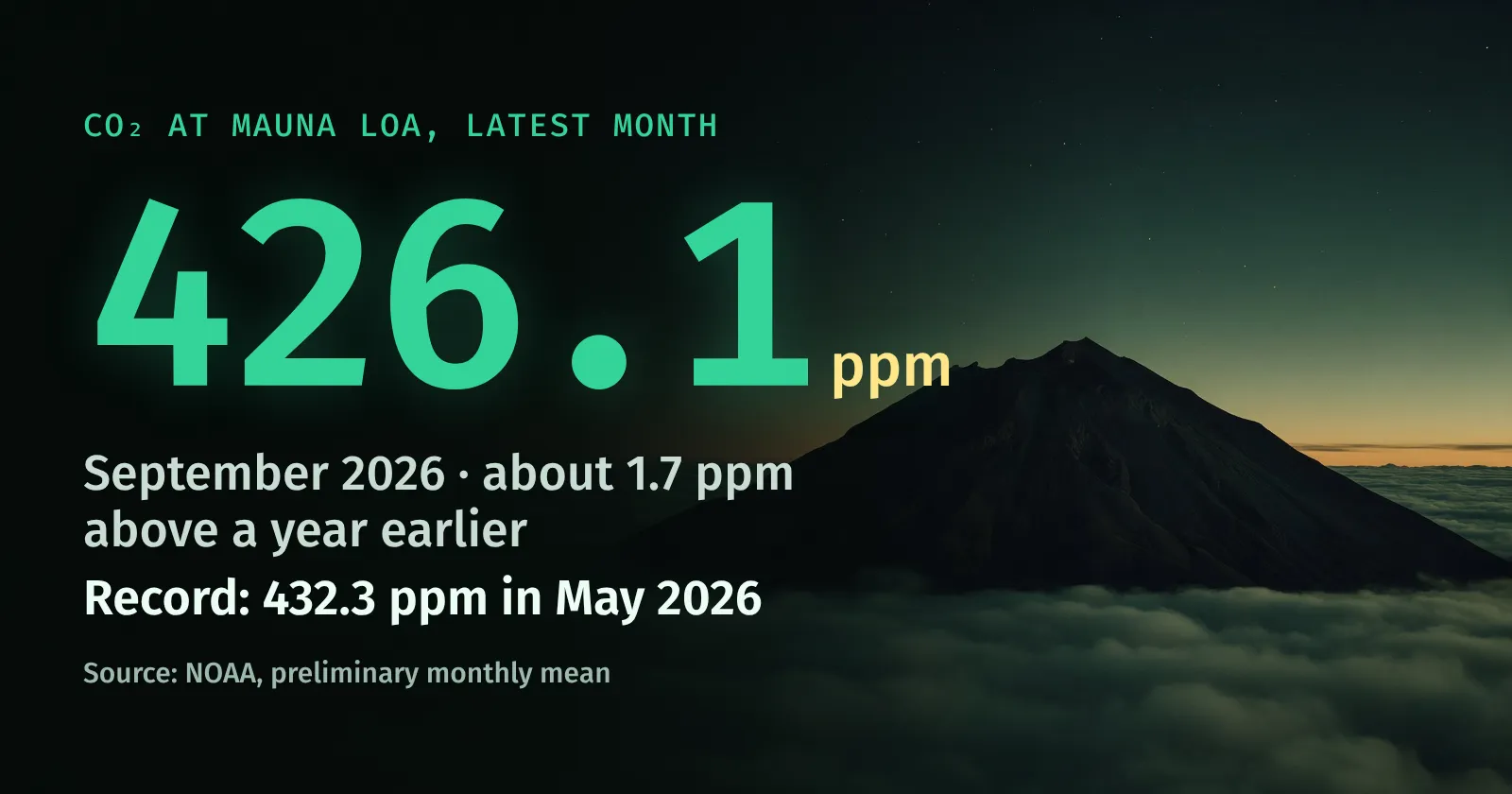
The report projects that atmospheric CO₂ averaged 425.7 ppm in 2025, up from 422.8 ppm in 2024. That is 52% above the pre-industrial level. The IPCC found that CO₂ concentrations are already higher than at any time in at least 2 million years.
Concentration is what drives warming, and it keeps rising as long as emissions exceed what the sinks remove. Even a fall in emissions would slow the increase, not reverse it. Only reaching net zero CO₂ stops concentrations from climbing.
How much carbon budget is left for 1.5 °C, 1.7 °C and 2 °C?
A carbon budget is the total amount of CO₂ that can still be emitted while keeping warming below a given level with a given probability. Because warming is roughly proportional to cumulative CO₂, the budget works like a fixed allowance: every year of emissions is subtracted from it.
| Warming limit | Remaining budget (Gt CO₂) | Years at 2025 emissions |
|---|---|---|
| 1.5 °C | 170 | about 4 |
| 1.7 °C | 525 | about 12 |
| 2 °C | 1,055 | about 25 |
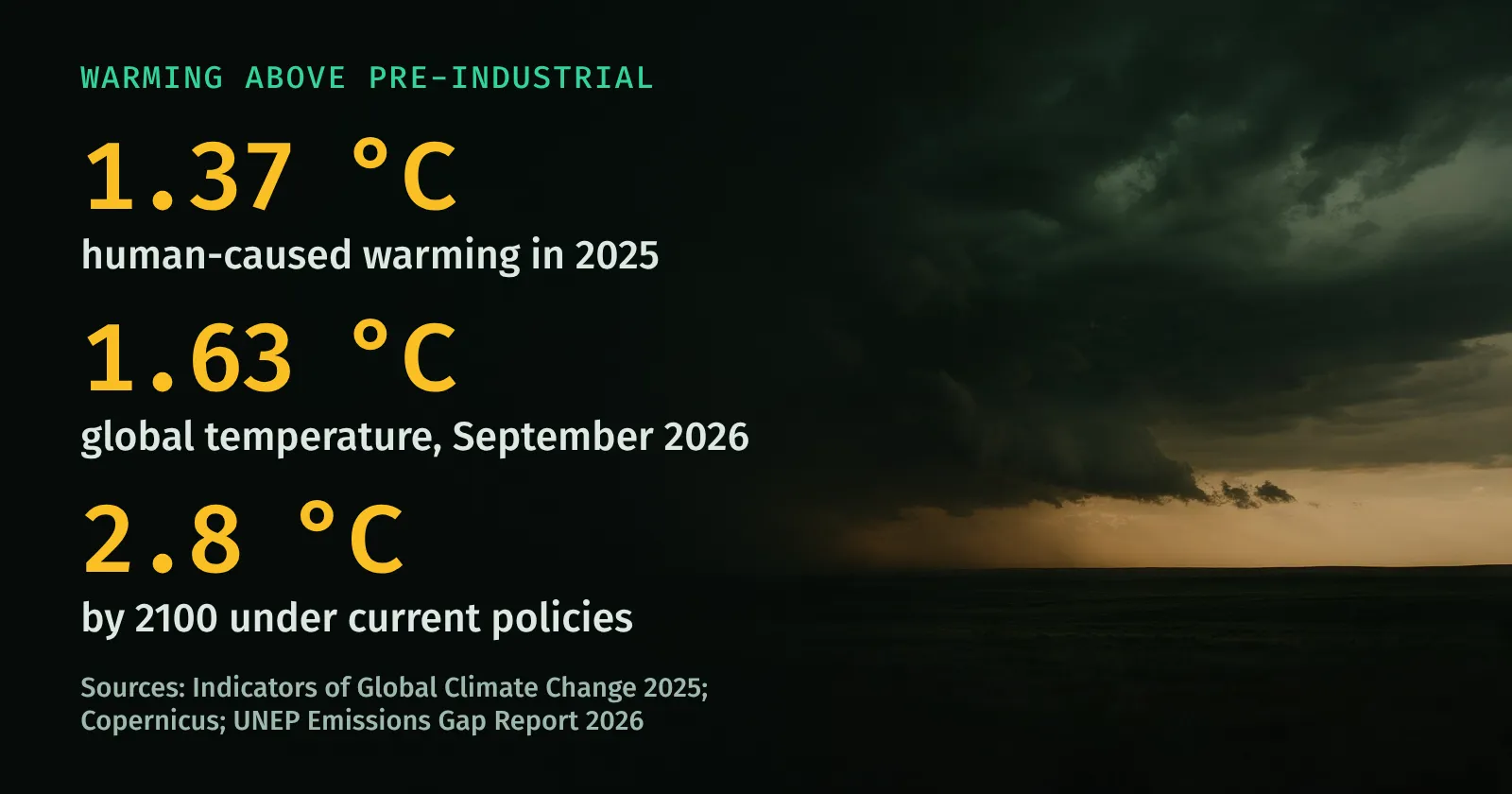
The authors describe the 1.5 °C budget as “virtually exhausted”. That does not mean 1.5 °C has already been passed as a long-term average; human-caused warming was about 1.37 °C in 2025. It means that at current emission rates, the CO₂ consistent with a 50:50 chance of staying under 1.5 °C will be used up around the end of the decade.
Why does another report say 130 Gt, not 170 Gt?
The Indicators of Global Climate Change (IGCC) project, led by Piers Forster at the University of Leeds, published its 2025 update in June 2026. It estimates a remaining 1.5 °C budget of 130 Gt CO₂ from the start of 2026, also for a 50% chance, or a little over three years at current emissions. It also found human-induced warming reached 1.37 °C in 2025 and is rising by about 0.27 °C per decade.
The two numbers differ because carbon budgets rest on several uncertain inputs:
- Warming so far: small differences in how much human-caused warming has already occurred change how much room is left.
- Non-CO₂ gases: future methane, nitrous oxide and aerosol emissions add or remove warming. The IPCC estimates that different non-CO₂ assumptions alone can move the 1.5 °C budget by around 220 Gt CO₂ either way.
- Methods and data: the teams use different model combinations and updated estimates of historical emissions.
Both estimates sit well inside each other’s uncertainty ranges. The practical message is the same: at today’s emissions, the 1.5 °C budget runs out between about 2029 and 2030.
What do the findings mean?
Three conclusions stand out. First, global fossil emissions are still rising, but slowly: growth of about 1% is far slower than in the 2000s, and dozens of countries are cutting emissions while their economies grow. Second, the natural sinks that absorb half of our CO₂ are weakening under warming, which leaves less margin for error. Third, limiting warming to 1.5 °C without temporarily overshooting it is now very unlikely; the realistic goal is to keep the peak as low as possible.
That makes every tonne count. The difference between the 1.7 °C and 2 °C budgets is about 530 Gt, more than a decade of current emissions, and each tenth of a degree avoided reduces heat extremes, sea-level rise and damage to ecosystems. For what the coming decade needs to look like, read our guide to climate change from 2025 to 2035.
Questions and answers
What is the Global Carbon Budget?
It is an annual, peer-reviewed assessment by the Global Carbon Project, an international team of more than 100 scientists, of how much CO₂ humans emit from fossil fuels and land use, and how much is absorbed by the ocean, land and atmosphere. The 2025 edition was released in November 2025 and published in Earth System Science Data in 2026.
What were global CO₂ emissions in 2025?
The Global Carbon Budget 2025 projects 38.1 billion tonnes of CO₂ from fossil fuels and cement (a record, up 1.1%) plus 4.1 billion tonnes from land-use change, for a total of 42.2 billion tonnes.
How much carbon budget is left for 1.5 °C?
About 170 billion tonnes of CO₂ from the start of 2026 for a 50% chance of limiting warming to 1.5 °C, according to the Global Carbon Budget 2025. That is roughly four years of emissions at the 2025 rate. The Indicators of Global Climate Change report gives a lower central estimate of 130 billion tonnes.
Why do carbon budget estimates differ?
Budgets depend on how much warming has already happened, how much extra warming methane and other non-CO₂ gases will add, and modelling choices. Small differences in these inputs shift the result by tens of billions of tonnes, so both 130 Gt and 170 Gt fall within the scientific uncertainty.
When is the Global Carbon Budget 2026 published?
The Global Carbon Project usually releases its annual update in November, during the UN climate conference. The 2026 edition is expected around COP31 in Antalya, Türkiye (9–20 November 2026).
Sources
- Fossil fuel CO₂ emissions hit record high in 2025 (press release), Global Carbon Project, 2025
- Friedlingstein et al., Global Carbon Budget 2025, Earth System Science Data, 2026
- The Global Carbon Budget FAQs 2025, Global Carbon Project, 2025
- Analysis: Fossil-fuel CO₂ emissions to set new record in 2025, as land sink ‘recovers’, Carbon Brief, 2025
- Global carbon dioxide emissions from fossil fuels rise in 2025, CSIRO, 2025
- Forster et al., Indicators of Global Climate Change 2025, Earth System Science Data, 2026
- Global warming reached 1.37 °C in 2025, Priestley Centre for Climate Futures, University of Leeds, 2026
- Climate Change 2021: The Physical Science Basis, Summary for Policymakers, IPCC, 2021
- CO₂ emissions, Our World in Data, 2025
- Global Energy Review 2026, International Energy Agency, 2026
- Global Electricity Review 2026, Ember, 2026