Food
Carbon footprint of food: what matters, what doesn’t, and the swaps that count
What you eat matters far more than where it comes from or how it’s packaged. Here is the data, food by food, and the changes that make a real difference.
The short answer: what you eat matters most
The biggest driver of your food’s carbon footprint is the type of food, not where it was grown, how it was packaged or how far it travelled. Beef, lamb and cheese sit at the top of almost every comparison; beans, peas, grains, fruit and vegetables sit at the bottom, often by a factor of 10 to 100.
So the most effective changes are simple: eat less red meat and cheese, replace some of it with poultry, eggs, pulses or tofu, and waste less of what you buy. Buying local and cutting packaging help a little, but much less than most people expect.
How much of global emissions comes from food?
The largest food study to date, by Joseph Poore and Thomas Nemecek (2018), drew on data from about 38,000 farms in 119 countries. It put food production at about 13.6 billion tonnes of CO₂-equivalent a year, or roughly 26% of global greenhouse gas emissions.
A 2021 study in Nature Food by Crippa and colleagues counted the whole food system, including packaging, retail, cooking and waste disposal, and arrived at about 18 billion tonnes, or 34% of the global total in 2015. The two numbers differ mainly in scope. Our World in Data summarises the range as roughly a quarter to a third.
For context, the world emitted about 42.2 billion tonnes of CO₂ from fossil fuels and land use in 2025 (you can watch it climb on the live CO₂ counter). Food emissions include more than CO₂: methane from cattle and rice paddies and nitrous oxide from fertiliser make up a large share, which is why they are measured in CO₂-equivalent (CO₂e).
Which foods have the highest carbon footprint?
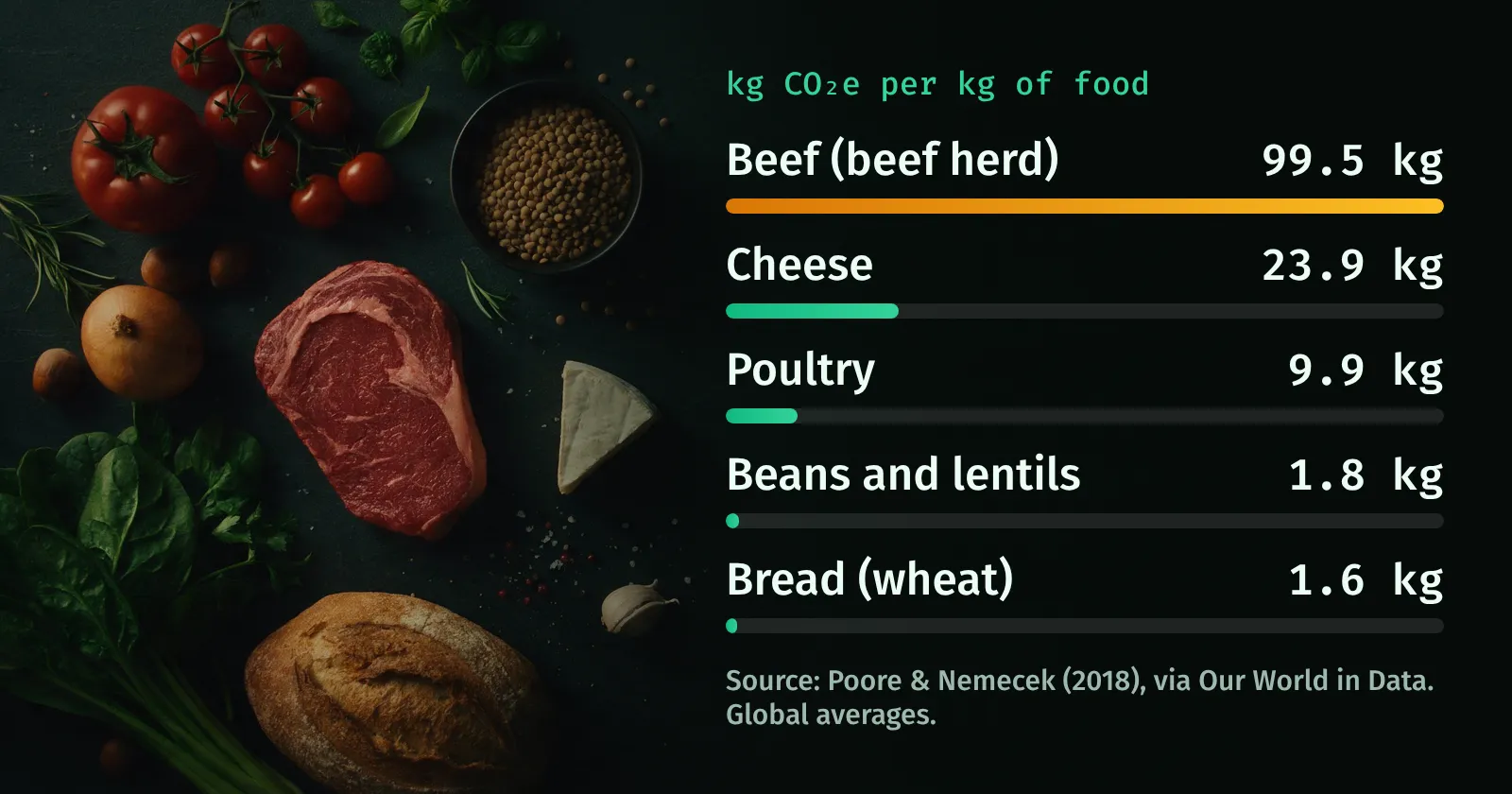
The table below uses the global averages from Poore & Nemecek, as published by Our World in Data. They cover the full supply chain from land use change and farming through processing, transport, packaging and retail. The per-protein column is the fairer comparison for meat, dairy and their alternatives.
| Food | kg CO₂e per kg | kg CO₂e per 100 g protein |
|---|---|---|
| Beef (beef herd) | 99.5 | 49.9 |
| Dark chocolate | 46.7 | – |
| Lamb and mutton | 39.7 | 19.9 |
| Beef (dairy herd) | 33.3 | 16.9 |
| Coffee | 28.5 | – |
| Prawns (farmed) | 26.9 | 18.2 |
| Cheese | 23.9 | 10.8 |
| Fish (farmed) | 13.6 | 6.0 |
| Pig meat | 12.3 | 7.6 |
| Poultry meat | 9.9 | 5.7 |
| Eggs | 4.7 | 4.2 |
| Rice | 4.5 | – |
| Tofu | 3.2 | 2.0 |
| Milk (cow’s) | 3.2 | – |
| Beans, lentils and other pulses | 1.8 | 0.8 |
| Wheat and rye (e.g. bread) | 1.6 | – |
| Peas | 1.0 | 0.4 |
| Bananas | 0.9 | – |
| Potatoes | 0.5 | – |
| Nuts | 0.4 | 0.3 |
A few things stand out:
- Ruminant meat is in a league of its own. Cattle and sheep need a lot of land and feed, and they produce methane as they digest. Per 100 g of protein, beef from beef herds emits about 120 times more than peas.
- Cheese is high because it is concentrated milk. It takes many litres of milk to make 1 kg of cheese, so its footprint per kg is close to pork and well above chicken.
- Chocolate and coffee look alarming per kg, but most people eat small amounts, so they rarely dominate a diet’s total. Much of their footprint comes from forest cleared to grow them.
- Rice is higher than other grains because flooded paddies release methane.
How much does changing your diet cut emissions?
The most useful real-world data comes from a 2023 Nature Food study led by Peter Scarborough at the University of Oxford. It linked what about 55,500 people in the UK actually ate to environmental data from over 38,000 farms.
| Diet | kg CO₂e per day | t CO₂e per year |
|---|---|---|
| High meat-eater (100 g+ meat a day) | 10.2 | 3.7 |
| Low meat-eater (under 50 g a day) | 5.4 | 2.0 |
| Vegan | 2.5 | 0.9 |
Vegans’ diets had about 25% of the greenhouse gas footprint of high meat-eaters (uncertainty range 15–37%). The study also found at least a 30% difference between low and high meat-eaters on most measures. In other words, moving from a heavy-meat diet to a low-meat one gets you nearly two-thirds of the way to a vegan footprint.
That means the popular claim that a plant-based diet “cuts emissions 73%” is roughly right only when compared with a high-meat diet, and only for food emissions, not your whole footprint. Compared with a low-meat diet, going vegan saves roughly half.
Why “eat local” matters less than what you eat
Transport, often called food miles, accounts for only about 5–6% of the emissions from food, according to Our World in Data. Most of that comes from trucks on the road. Ships carry nearly 60% of food miles but with low emissions per tonne, and air freight carries only about 0.16% of food miles.
For most foods, transport is under 10% of the total footprint, and for beef from beef herds it is around 0.5%. A steak from the farm down the road therefore still has many times the footprint of beans shipped across an ocean.
One study (Li et al., 2022) estimated a higher share, about 19%, by counting the full supply chains of fertiliser, machinery and other inputs. Even then, the type of food remains the bigger lever.
Packaging is similar: it typically makes up a small share of a food’s footprint, and good packaging can reduce emissions by preventing waste.
How much do food waste and loss add?
The UN Environment Programme’s Food Waste Index Report 2024 estimates that 1.05 billion tonnes of food were wasted in 2022, about 132 kg per person and almost a fifth of all food available to consumers. Households were responsible for 60% of it, about 79 kg per person a year; food service accounted for 28% and retail 12%.
Including food lost earlier in the supply chain, UNEP estimates that food loss and waste causes 8–10% of global greenhouse gas emissions, almost five times the emissions of aviation. Household waste levels are surprisingly similar across rich and middle-income countries, so this is not only a wealthy-country problem.
Wasting high-footprint food hurts most: binning a block of cheese or leftover beef wastes far more emissions than throwing away a few potatoes.
- Plan meals and write a shopping list before you shop.
- Check the fridge and freezer first and use up what is there.
- Freeze bread, leftovers and meat you won’t use in time.
- Learn the difference between “use by” (safety) and “best before” (quality).
- Compost unavoidable scraps or use food waste collection where it exists, so they don’t rot in landfill and release methane.
Practical swaps and roughly how much they save
The savings below are estimates calculated from the per-kg averages in the table above. Real figures depend on where your food comes from and what you eat instead, but the ranking is reliable.
| Change | Approx. saving per year |
|---|---|
| Swap two beef meals a week (13 kg a year) for beans or lentils | ~1,250 kg CO₂e |
| Swap two beef meals a week for chicken | ~1,150 kg CO₂e |
| Swap two lamb meals a week for chicken | ~390 kg CO₂e |
| Swap one pork meal a week (6.5 kg a year) for tofu | ~60 kg CO₂e |
| Halve cheese from 10 kg to 5 kg a year | ~120 kg CO₂e |
| Swap 1 litre of cow’s milk a week for soy milk | ~110 kg CO₂e |
If your beef comes from dairy herds, as much European beef does, the beef savings are about a third of those shown. They are still among the largest changes you can make in the kitchen.
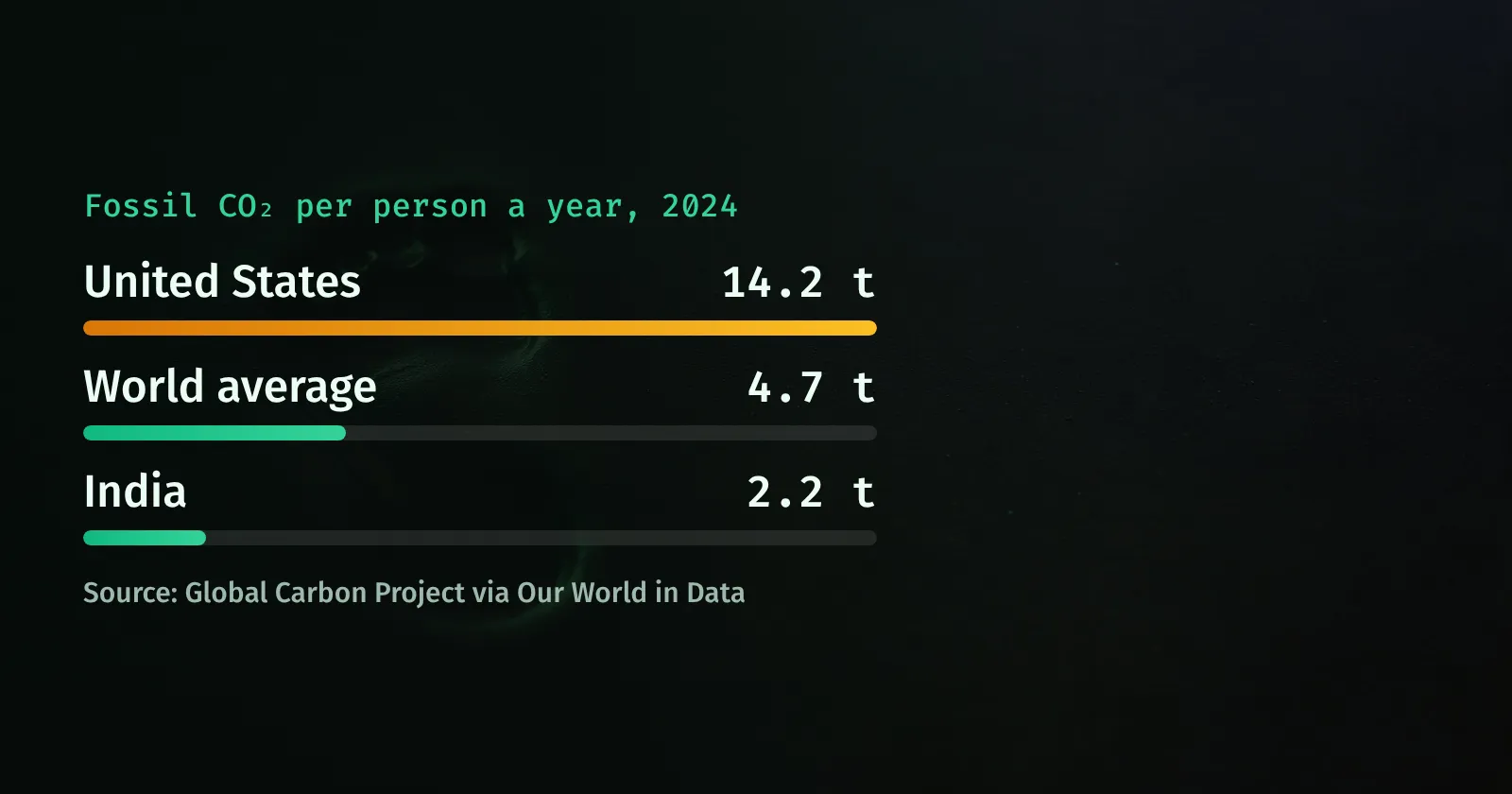
For comparison, the world average is about 4.7 tonnes of fossil CO₂ per person per year. To see how food compares with your energy and travel, try our guide to carbon footprint calculators.
What about cooking, packaging and organic food?
Cooking energy is a modest part of food’s footprint. Using lids, a microwave, a pressure cooker or batch cooking all help, and they mostly save money on energy bills. Our guide to saving energy at home covers the kitchen.
Organic and grass-fed labels don’t reliably mean lower emissions. Our World in Data’s review of the evidence concludes that eating less meat is nearly always better than switching to “sustainable” meat, because even the lowest-impact beef and lamb stay well above plant proteins.
Food emissions also vary a lot by country, depending on diets and how much forest is cleared for farming. The CO₂ emissions by country ranking shows fossil CO₂ for each nation; for agriculture-heavy economies such as Brazil, land use change adds a large extra share.
Questions and answers
Which foods have the highest carbon footprint?
Per kilogram, beef from beef herds is highest at about 99.5 kg CO₂e, followed by dark chocolate (46.7), lamb and mutton (39.7), beef from dairy herds (33.3), coffee (28.5), farmed prawns (26.9) and cheese (23.9), using global averages from Poore & Nemecek (2018). Chocolate and coffee are eaten in small amounts, so beef, lamb and cheese usually dominate a diet’s footprint.
Does eating less meat really reduce emissions?
Yes. A 2023 Nature Food study of about 55,500 UK adults found high meat-eaters’ diets produced around 10.2 kg CO₂e per day, low meat-eaters’ about 5.4 kg and vegans’ about 2.5 kg. Cutting red meat and cheese gives most of the benefit, even without going fully vegan.
Is eating local food better for the climate?
Usually only slightly. Transport makes up about 5–6% of food’s total emissions, so a local steak still has a far bigger footprint than imported beans. The exception is air-freighted produce, such as some berries, asparagus and fine beans, which is worth avoiding.
How much of global emissions comes from food?
Estimates range from about 26% (Poore & Nemecek, food only) to 34% (Crippa et al. 2021, the whole food system including packaging, retail and waste). Our World in Data summarises it as roughly a quarter to a third.
Is chicken better than beef for the climate?
Much better. Poultry averages about 9.9 kg CO₂e per kg, around a tenth of beef from beef herds (99.5 kg). Per 100 g of protein it is 5.7 kg versus 49.9 kg. Beans, peas and tofu are lower still.
Sources
- Reducing food’s environmental impacts through producers and consumers, Poore & Nemecek, Science, 2018
- Greenhouse gas emissions per kilogram of food product, Our World in Data (Poore & Nemecek 2018)
- Greenhouse gas emissions per 100 grams of protein, Our World in Data (Poore & Nemecek 2018)
- Vegans, vegetarians, fish-eaters and meat-eaters in the UK show discrepant environmental impacts, Scarborough et al., Nature Food, 2023
- How much of global greenhouse gas emissions come from food?, Our World in Data, 2021
- Food systems are responsible for a third of global anthropogenic GHG emissions, Crippa et al., Nature Food, 2021
- You want to reduce the carbon footprint of your food? Focus on what you eat, not whether your food is local, Our World in Data
- Most carbon emissions from food miles are produced by trucks on the road, Our World in Data, 2024
- Food Waste Index Report 2024, UN Environment Programme
- Environmental footprints of dairy and plant-based milks, Our World in Data (Poore & Nemecek 2018)
- Global food-miles account for nearly 20% of total food-systems emissions, Li et al., Nature Food, 2022
- Less meat is nearly always better than sustainable meat, Our World in Data