Climate science
Climate outlook 2026: emissions, warming and what to watch
2026 has brought an oil shock, a strong El Niño and new national climate plans. Here is what the latest data says about emissions and warming this year, and what to watch next.
The 2026 climate outlook in brief
Global fossil CO₂ emissions may fall slightly in 2026 for the first time since the pandemic. A Carbon Brief analysis published in September 2026 projects a drop of about 0.5%, because the closure of the Strait of Hormuz cut oil and gas use. That would be a small dent in a record 2025 total of 38.1 Gt, and it is driven by an energy crisis rather than by climate policy.
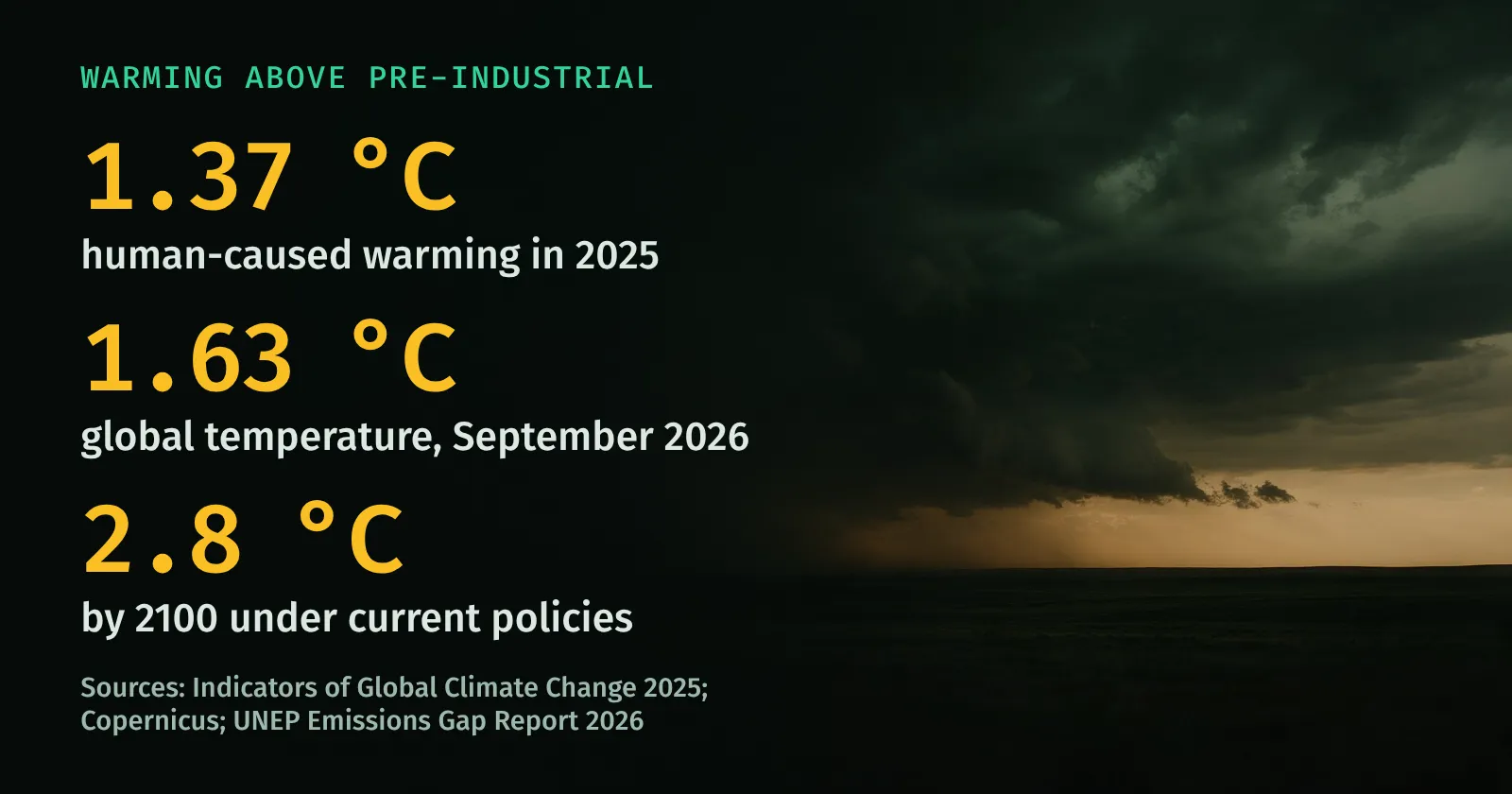
Warming, meanwhile, continues. Human-caused warming reached about 1.37 °C in 2025, and a strong El Niño has pushed monthly global temperatures back above 1.5 °C since August 2026. The big policy moment of the year is COP31 in Antalya, Türkiye, from 9 to 20 November.
Where are global emissions heading in 2026?
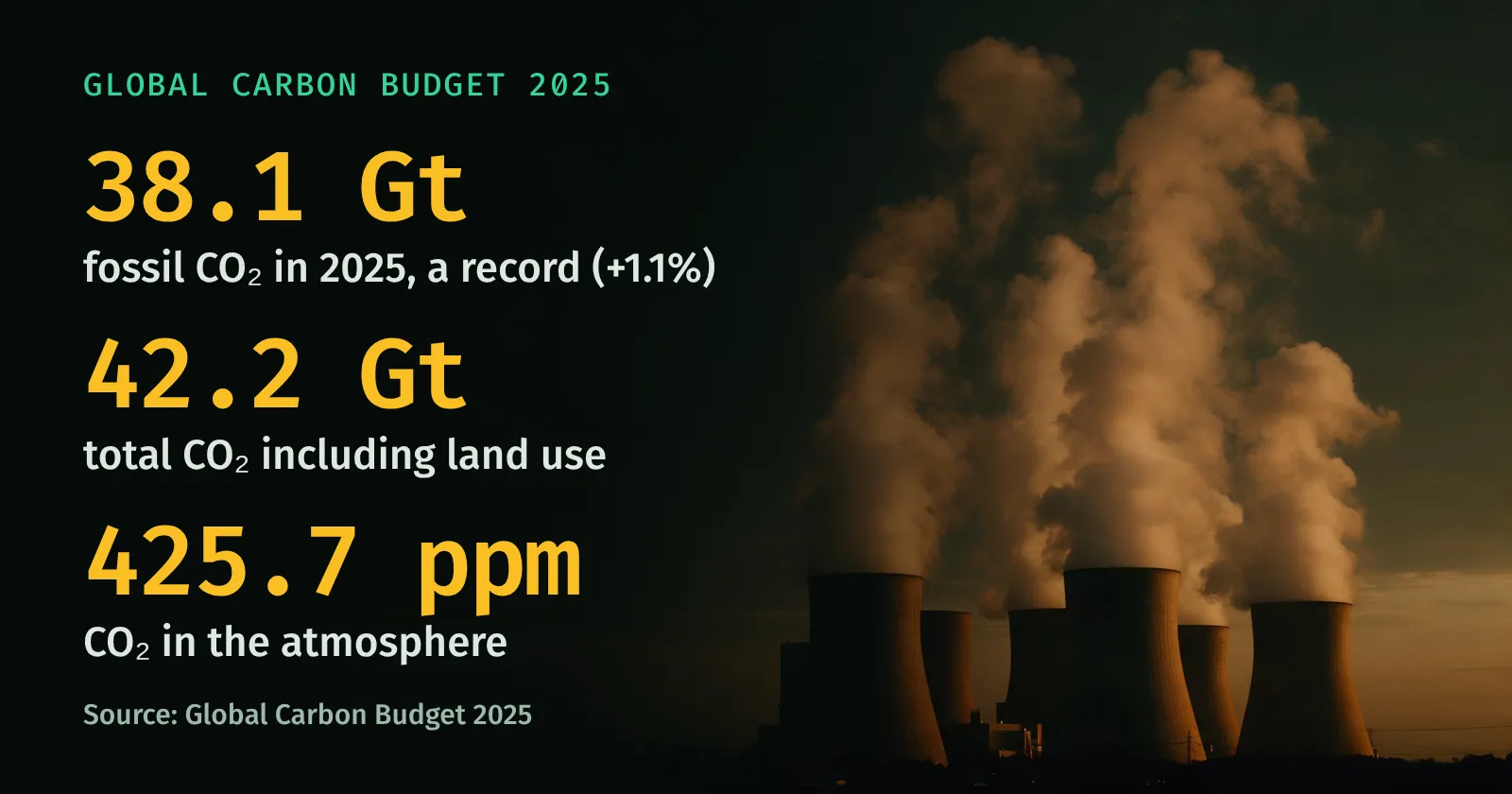
The starting point is a record. The Global Carbon Budget 2025 projected fossil CO₂ of 38.1 Gt in 2025 (+1.1%) and total CO₂ of 42.2 Gt including land use. The International Energy Agency’s own count found energy-related CO₂ grew only about 0.4% in 2025, the slowest rise since 2021, and estimates that clean technologies deployed since 2019 now avoid around 3 Gt of CO₂ a year.
2026 has been shaped by the Iran war and the disruption of shipping through the Strait of Hormuz, which the IEA called the largest supply disruption in the history of the oil market. Its October 2026 Oil Market Report expects world oil demand to fall by roughly 2.5 million barrels a day this year, the first annual decline since 2020.
- Projection for 2026 (Carbon Brief): oil demand −2.4%, gas −0.6%, coal +1.2%, giving fossil CO₂ about 0.5% lower than in 2025.
- China: CO₂ rose about 2% in the first quarter and fell about 1% in the second, leaving the first half roughly flat and still below the 2023–24 peak, according to CREA analysis for Carbon Brief.
- 2027: the IEA expects oil demand to partly recover, so a 2026 dip may not last.
Has global CO₂ peaked? Not yet in any lasting sense. A fall caused by high prices and shortages is very different from a structural decline driven by clean energy replacing fossil fuels. Watch the live total on our real-time CO₂ counter, which runs at the 2025 rate of about 1,338 tonnes per second.
How warm is the world in 2026?
Recent years have been the warmest on record. Copernicus data show 2024 was the warmest year at about 1.60 °C above the 1850–1900 average, and 2025 the third-warmest at 1.47 °C, only 0.01 °C below 2023. For the first time, a three-year period (2023–2025) averaged more than 1.5 °C. The WMO, which combines several datasets, put 2025 at about 1.43 °C and confirmed 2015–2025 as the 11 warmest years on record.
In 2026 a strong El Niño has developed in the Pacific. September 2026 was the second-warmest September on record at 1.63 °C above pre-industrial, and the second month in a row above 1.5 °C, according to Copernicus. In July, Carbon Brief estimated that 2026 would most likely be the second-warmest year (around 1.51 °C), with about a 35% chance of beating the record. Because El Niño’s effect on global temperature lags by several months, 2027 could be warmer still.
| Measure | Value |
|---|---|
| 2024 global temperature (warmest year) | 1.60 °C |
| 2025 global temperature (third-warmest) | 1.47 °C |
| Human-caused warming, 2025 | 1.37 °C |
| Rate of warming, 2016–2025 | 0.27 °C per decade |
| Chance 2026–2030 average exceeds 1.5 °C | 75% |
| Chance at least one year in 2026–2030 exceeds 1.5 °C | 91% |
Hot single years are not the same as passing the Paris Agreement limit, which refers to warming averaged over about two decades. The more useful measure is human-caused warming, estimated by the Indicators of Global Climate Change project at 1.37 °C in 2025. At the current pace it reaches 1.5 °C around 2030.
Which climate events and policies matter in 2026?
COP31 in Antalya
COP31 runs from 9 to 20 November 2026 in Antalya, Türkiye, with a leaders’ summit on 11–12 November. In an unusual arrangement, Türkiye holds the presidency while Australia’s climate and energy minister, Chris Bowen, presides over the negotiations. Key issues include the response to the gap between national plans and the Paris goals, adaptation finance, and whether to bring work on transitioning away from fossil fuels into the formal process.
New national climate plans (NDCs 3.0)
Countries were due to submit new targets for 2035 in 2025, and submissions have continued into 2026. Some of the largest:
- China: cut economy-wide net greenhouse gas emissions 7–10% below peak levels by 2035, its first absolute target covering all gases.
- European Union: a 66.25–72.5% cut below 1990 by 2035, and a legally binding 2040 target of 90% (at least 85% domestic, up to 5% from international credits) adopted in March 2026.
- India: submitted in April 2026: a 47% cut in emissions intensity of GDP from 2005 levels by 2035 and 60% non-fossil power capacity.
- United States: its withdrawal from the Paris Agreement took effect on 27 January 2026, and in January 2026 the administration announced it would also leave the UN climate convention (UNFCCC).
The emissions gap
UNEP’s Emissions Gap Report 2026, published on 21 October, projects warming of about 2.8 °C by 2100 under current policies, 2.6 °C if all NDCs are met and around 2.1 °C if net-zero pledges are also achieved. Fully implemented, NDCs would cut emissions only 11–15% below 2025 levels by 2035, against the 45% needed on UNEP’s lowest-overshoot pathway.
Outside the UN process
In April 2026, 57 countries met in Santa Marta, Colombia, for the first conference on transitioning away from fossil fuels, agreeing to develop national roadmaps. A second meeting is planned in Tuvalu in 2027.
Is clean energy still growing in 2026?
Yes. Clean power is the main reason emissions growth has slowed. According to Ember, solar generation rose by a record 30% in 2025 and met 75% of the growth in global electricity demand; together, wind and solar met 99% of it. Fossil power generation did not increase in 2025, and renewables produced more electricity than coal for the first time.
Electric cars are following a similar path. The IEA reports more than 20 million electric car sales in 2025, about a quarter of new cars, and expects about 23 million in 2026, close to 30%, despite an 8% dip in the first quarter after policy changes in China and the US. High fuel prices during the oil crisis have made electric vehicles more attractive in many markets.
For a practical look at the technologies involved, see our renewable energy guide.
What to watch for the rest of 2026
- COP31 outcomes (9–20 November): any agreed response to the NDC gap, adaptation finance and fossil-fuel transition language.
- Global Carbon Budget 2026 (expected November): the first full estimate of whether fossil CO₂ fell in 2026. We will update our Global Carbon Budget explainer when it is published.
- El Niño’s peak: whether 2026 sets a new temperature record, and how high forecasts go for 2027.
- Oil market recovery: whether a recovery in shipping through Hormuz brings oil use back up, or whether some demand has been permanently replaced by electrification.
- China’s full-year emissions: a second year of flat or falling CO₂ would strengthen the case that its emissions have peaked. See the latest figures on our China CO₂ page and the CO₂ emissions by country ranking.
Looking further ahead? Our guide to the next decade of climate change covers when 1.5 °C is likely to be crossed and what 2030 and 2035 targets require.
Questions and answers
Will global emissions fall in 2026?
Possibly, for the first time since 2020. A September 2026 Carbon Brief analysis projects global fossil CO₂ emissions to fall about 0.5%, because the closure of the Strait of Hormuz cut oil and gas use. This is a projection, and it is driven by a supply shock rather than lasting climate policy, so it could reverse in 2027.
Will 2026 be the hottest year on record?
It might. A strong El Niño has developed, and September 2026 was the second-warmest September on record at 1.63 °C above pre-industrial (Copernicus). Carbon Brief’s July estimate put 2026 most likely second-warmest, with about a one-in-three chance of a record. El Niño’s full effect usually peaks the following year, so 2027 is also a candidate.
Has the world passed 1.5 °C of warming?
Not as a long-term average. Single years and the 2023–2025 average have exceeded 1.5 °C, but the Paris Agreement refers to warming averaged over about 20 years. Human-caused warming was about 1.37 °C in 2025 and, at current rates, will reach 1.5 °C around 2030.
Where is COP31 in 2026?
COP31 takes place in Antalya, Türkiye, from 9 to 20 November 2026. Türkiye holds the COP presidency and Australia leads the negotiations under a shared arrangement agreed at COP30.
How much warming are we heading for?
UNEP’s Emissions Gap Report 2026 projects about 2.8 °C by 2100 under current policies, 2.6 °C if all national climate plans (NDCs) are fully implemented, and around 2.1 °C if net-zero pledges are also met.
Sources
- Analysis: Global fossil-fuel emissions set to fall in 2026 amid Hormuz crisis, Carbon Brief, 2026
- Oil Market Report, October 2026, International Energy Agency, 2026
- Analysis: China’s CO₂ emissions fall in Q2 2026 due to plummeting oil use, Carbon Brief / CREA, 2026
- Global Carbon Budget 2025, Global Carbon Project, 2025
- Global Energy Review 2026, International Energy Agency, 2026
- Global Climate Highlights 2025: 2025 was the third-warmest year on record, Copernicus / ECMWF, 2026
- Second warmest September as global temperatures stay above 1.5 °C, Copernicus Climate Change Service, 2026
- State of the Global Climate 2025, World Meteorological Organization, 2026
- Global Annual to Decadal Climate Update 2026–2030, World Meteorological Organization, 2026
- State of the climate: Strong El Niño puts 2026 on track for second-warmest year, Carbon Brief, 2026
- Forster et al., Indicators of Global Climate Change 2025, Earth System Science Data, 2026
- Emissions Gap Report 2026: The Point of Return, UN Environment Programme, 2026
- Global Electricity Review 2026, Ember, 2026
- Global EV Outlook 2026, International Energy Agency, 2026
- Türkiye sets COP31 dates, Climate Home News, 2026
- Paris Climate Agreement withdrawal tracker, Harvard Environmental and Energy Law Program, 2026
- 2040 climate target, European Commission, 2026
- India’s Nationally Determined Contribution (2031–2035), UNFCCC, 2026
- Santa Marta: key outcomes from first summit on transitioning away from fossil fuels, Carbon Brief, 2026