Climate science
The next decade of climate change: what to expect from 2025 to 2035
The decade to 2035 decides how high global warming peaks. Here is what the science expects, what current pledges add up to, and the actions that make the biggest difference.
The next 10 years of climate change in brief
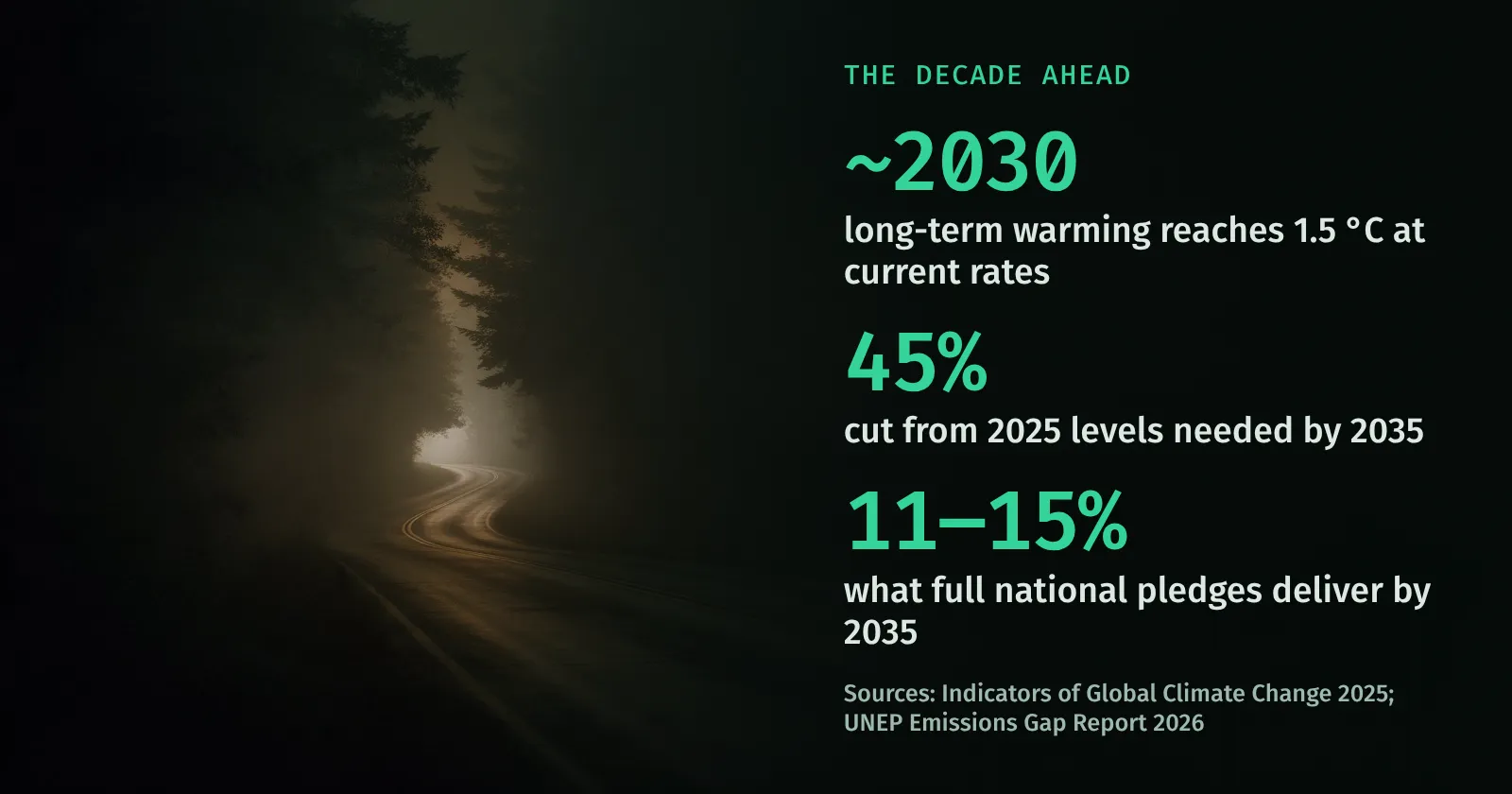
Over the next decade the world is very likely to pass 1.5 °C of long-term warming, most likely around 2030. Human-caused warming was about 1.37 °C in 2025 and is rising by about 0.27 °C per decade, according to the Indicators of Global Climate Change 2025 report. That implies roughly 1.6–1.7 °C by the mid-2030s if the current pace continues.
What is still open is how high warming peaks and how fast. UNEP’s Emissions Gap Report 2026 finds that today’s policies lead to about 2.8 °C by 2100, while rapid cuts this decade could hold the peak to 1.7–1.8 °C and bring temperatures back towards 1.5 °C by the end of the century. The years to 2035 decide which path the world is on.
When will 1.5 °C be crossed?
It depends on what “crossed” means. Single years have already exceeded 1.5 °C (2024 was about 1.6 °C), and Copernicus found that 2023–2025 was the first three-year period above it. But the Paris Agreement limit refers to warming averaged over about 20 years, which smooths out natural swings such as El Niño.
- IPCC (2023): 1.5 °C is more likely than not to be reached in the near term, with best estimates in the early 2030s, even under very low emission scenarios.
- Indicators of Global Climate Change (2026): at current emission rates, human-caused warming reaches 1.5 °C in about four years, around 2030.
- WMO decadal forecast (May 2026): a 75% chance that the 2026–2030 average exceeds 1.5 °C, and a 91% chance that at least one of those years does.
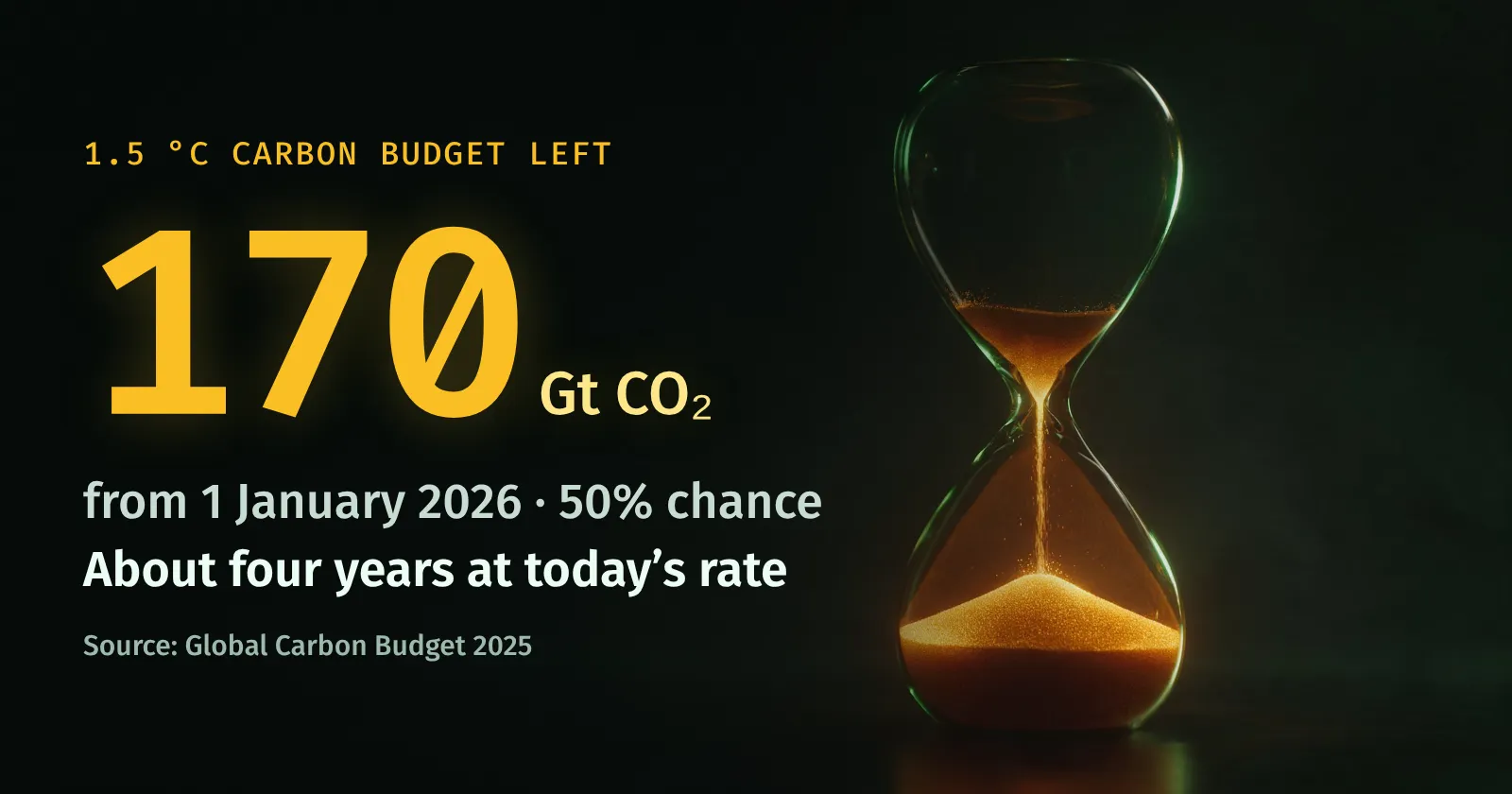
- Carbon budget: the Global Carbon Budget 2025 estimates 170 Gt CO₂ remained from the start of 2026 for a 50% chance of 1.5 °C, about four years of current emissions. Our Global Carbon Budget explainer covers why another estimate puts it at 130 Gt.
Passing 1.5 °C is not a cliff edge. Climate risks rise steadily with each increment of warming, which is why the IPCC stresses that every fraction of a degree matters.
What do the 2030 and 2035 targets require?
Two widely used benchmarks describe the cuts needed. They use different base years, so the percentages are not directly comparable.
| Benchmark | By 2030 | By 2035 | By 2040 |
|---|---|---|---|
| IPCC: 1.5 °C with limited overshoot (vs 2019) | −43% | −60% | −69% |
| UNEP 2026: lowest-overshoot path (vs 2025) | −18% | −45% | −69% |
| UNEP 2026: all national pledges met (vs 2025) | −5% to −8% | −11% to −15% | – |
The IPCC pathways also reach net zero CO₂ around the early 2050s for 1.5 °C and the early 2070s for 2 °C. The gap between what is needed and what is pledged for 2035 is large: pledges deliver roughly a quarter to a third of the cut on UNEP’s lowest-overshoot path. UNEP estimates that every five years of delay adds about 0.1 °C to the eventual peak.
How much warming are current policies heading for?
Projections depend on whether countries only keep the policies they have, meet their official targets, or also deliver long-term net-zero pledges.
| Scenario | UNEP 2026 | Climate Action Tracker |
|---|---|---|
| Current policies | 2.8 °C | 2.6 °C |
| National pledges (NDCs) met | 2.6 °C | – |
| Pledges plus net-zero targets | about 2.1 °C | 2.2 °C (pledges and targets), 1.9 °C (optimistic) |
UNEP’s 2026 projections are slightly higher than its 2025 edition, partly because of the US withdrawal from the Paris Agreement and revised historical emissions. Climate Action Tracker found its outlook has barely changed in four years. Both agree on the core point: the world is on course for well above 2 °C unless implementation speeds up.
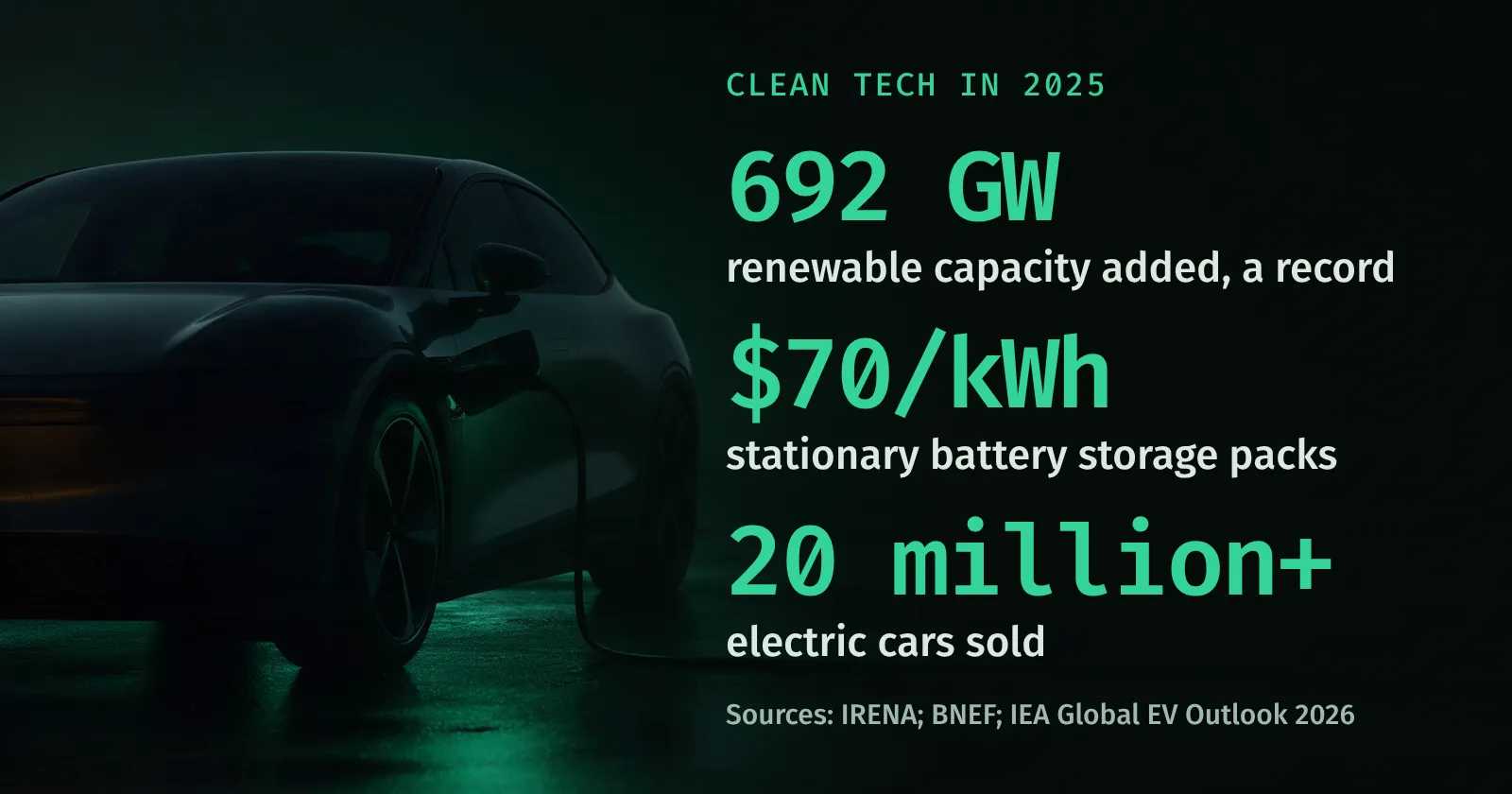
There is real progress underneath these numbers. The IEA estimates that clean technologies installed since 2019 avoid about 3 Gt of CO₂ a year, and Ember found that wind and solar met 99% of the growth in global electricity demand in 2025. The question for the next decade is whether that growth becomes fast enough to push total emissions down, not just to slow their rise. You can follow the global total on our live CO₂ emissions counter.
How much adaptation will the next decade need?
Even with fast emission cuts, the next decade will bring more heat, heavier rainfall and droughts, so adaptation has become as urgent as mitigation. UNEP’s Adaptation Gap Report 2025 estimates that developing countries will need over $310 billion a year for adaptation by 2035, about 12 times current international public adaptation finance, which fell to around $26 billion in 2023.
At COP30 in Belém, governments called for at least tripling adaptation finance by 2035 and agreed a set of indicators to track progress on the global adaptation goal. Priorities that recur across the IPCC and UNEP assessments include:
- early-warning systems for heatwaves, floods and storms;
- heat-resilient buildings, cooling and urban green space;
- water storage, efficient irrigation and drought-tolerant crops;
- protecting and restoring wetlands, mangroves and forests, which also store carbon.
What can countries do between now and 2035?
The biggest near-term opportunities are well known and largely affordable:
- Clean electricity: meet the COP28 goal of tripling renewable capacity and doubling the rate of energy-efficiency improvement by 2030, and build the grids and storage to use it.
- Electrify transport, heat and industry so that clean power replaces oil and gas in end uses.
- Cut methane: more than 150 countries back the Global Methane Pledge to cut emissions 30% below 2020 levels by 2030. Methane cuts slow warming quickly because the gas is short-lived.
- Halt deforestation: land-use emissions are already falling, and protecting forests keeps natural carbon sinks working.
- Strengthen 2035 targets and turn them into laws and budgets, since pledges only count when implemented.
What can individuals do?
Personal choices add up. The IPCC found that demand-side changes, from how we travel and heat homes to what we eat, could reduce greenhouse gas emissions in end-use sectors by 40–70% by 2050 compared with current policy baselines. The largest household sources are usually home energy, transport and food:
- Home energy: insulation, heat pumps and efficient appliances. See our guide to saving energy at home.
- Transport: fewer flights, more walking, cycling and public transport, and an electric car when you replace one. See our transport and climate guide.
- Food: less red meat and less food waste. See our food climate solutions.
- Civic action: vote, talk about climate and support local adaptation and clean-energy projects; policy sets the pace for everyone.
The next decade will not be easy, but it is not a lost cause. The difference between a world that peaks at 1.7 °C and one heading towards 2.8 °C is enormous, and most of it is still to be decided.
Questions and answers
When will the world pass 1.5 °C of warming?
As a long-term average, most likely around 2030. The Indicators of Global Climate Change 2025 report estimates human-caused warming at 1.37 °C in 2025, rising about 0.27 °C per decade. The IPCC found that 1.5 °C is more likely than not to be reached in the early 2030s even under very low emission scenarios.
What will happen to the climate by 2035?
At the current rate of about 0.27 °C per decade, long-term warming would be around 1.6–1.7 °C by 2035, with more frequent and intense heatwaves, heavy rainfall and droughts. How fast emissions fall this decade decides whether warming then levels off near 1.7 °C or keeps rising towards 2.5–3 °C by 2100.
What are the 2030 climate targets?
To keep 1.5 °C within reach with limited overshoot, the IPCC found global greenhouse gas emissions need to fall about 43% by 2030 and 60% by 2035 from 2019 levels. UNEP’s 2026 report, using 2025 as the baseline, calls for cuts of 18% by 2030 and 45% by 2035. Current national plans fall far short.
Is it too late to stop climate change?
It is too late to avoid exceeding 1.5 °C for at least some decades, but not too late to limit the damage. Each tenth of a degree avoided reduces risks, and UNEP finds a pathway that peaks at 1.7–1.8 °C and returns towards 1.5 °C by 2100 is still possible with rapid cuts.
Sources
- Forster et al., Indicators of Global Climate Change 2025, Earth System Science Data, 2026
- Global warming reached 1.37 °C in 2025, Priestley Centre for Climate Futures, University of Leeds, 2026
- AR6 Synthesis Report: Climate Change 2023, Summary for Policymakers, IPCC, 2023
- Climate Change 2022: Mitigation of Climate Change, Summary for Policymakers, IPCC, 2022
- Global Annual to Decadal Climate Update 2026–2030, World Meteorological Organization, 2026
- Emissions Gap Report 2026: The Point of Return, UN Environment Programme, 2026
- New UNEP report lays out emission cuts needed for return to 1.5 °C, UN Environment Programme, 2026
- Warming projections global update, November 2025, Climate Action Tracker, 2025
- Global Carbon Budget 2025, Global Carbon Project, 2025
- Adaptation Gap Report 2025: Running on Empty, UN Environment Programme, 2025
- COP30: key negotiations-related outcomes of the UN climate conference in Belém, C2ES, 2025
- Global Energy Review 2026, International Energy Agency, 2026
- Global Electricity Review 2026, Ember, 2026
- Global Methane Pledge, Climate and Clean Air Coalition
- Outcome of the first global stocktake (decision 1/CMA.5), UNFCCC, 2023