Climate tech
Climate technology in 2026: what’s working, what’s scaling and what’s still hype
Solar, wind, batteries and electric cars are cheap and growing fast. Green hydrogen, direct air capture and small modular reactors are real but early, expensive and far from the scale needed.
The short answer: the cheap technologies are already here
The climate technologies doing the heavy lifting in 2026 are not new inventions. Solar panels, wind turbines, lithium-ion batteries, electric cars and heat pumps are mature, often the cheapest option, and are being installed at record rates. In 2025, renewables overtook coal as the world’s largest source of electricity for the first time in about a century.
The technologies that dominate headlines, such as direct air capture, green hydrogen and small modular reactors, are real, but they remain early-stage, expensive and thousands of times smaller than the scale climate scenarios assume. They may matter a lot after 2030. For now, the fastest emission cuts come from deploying what already works.
That matters because time is short. Fossil CO₂ emissions hit a record 38.1 billion tonnes in 2025, and the remaining budget for a 50% chance of limiting warming to 1.5 °C is about 170 billion tonnes, roughly four years at current rates (Global Carbon Budget 2025). You can watch emissions accumulate on the live CO₂ counter.
Climate technology scorecard for 2026
| Technology | Status 2026 | Cost trend | Scale today vs needed |
|---|---|---|---|
| Solar PV | Mature, mass market | $0.043/kWh average for new plants (2024), among the cheapest power ever | 511 GW added in 2025, a record; the largest generation increase of any source |
| Onshore wind | Mature | $0.034/kWh, the cheapest new renewable power (2024) | About 159 GW of wind added in 2025 |
| Lithium-ion batteries | Mature, scaling fast | Packs $108/kWh; stationary storage $70/kWh, down about 45% in a year | Record installations in 2025; grid storage now the cheapest segment |
| Electric cars | Mainstream in China and Europe | EV battery packs averaged $99/kWh in 2025 | Over 20 million sold in 2025, about 25% of new cars; IEA expects ~29% in 2026 |
| Heat pumps | Mature | 3–5 times more efficient than gas boilers; upfront cost still a barrier | Global sales down about 2% in 2025, but Europe up 11% |
| Carbon capture and storage (CCS) | Proven at specific sites, slow to scale | Cheapest for concentrated CO₂ streams; costly elsewhere | About 64 Mt a year operating (2025) vs about 1,000 Mt needed by 2030 |
| Green hydrogen | Early commercial, many projects cancelled or delayed | $3.7–11.7/kg vs $1.1–2.4/kg for fossil hydrogen | Under 1% of hydrogen supply; about 1 Mt of low-emissions hydrogen in 2025 |
| Direct air capture (DAC) | Demonstration | Roughly $1,000 per tonne today; target $400–600 by 2030 | About 0.01 Mt a year vs about 70 Mt needed by 2030 |
| Small modular reactors (SMRs) | First units under construction | First-of-a-kind costs high and uncertain | First Western unit targeted for end-2030 |
Solar and wind: the fastest-growing energy sources in history
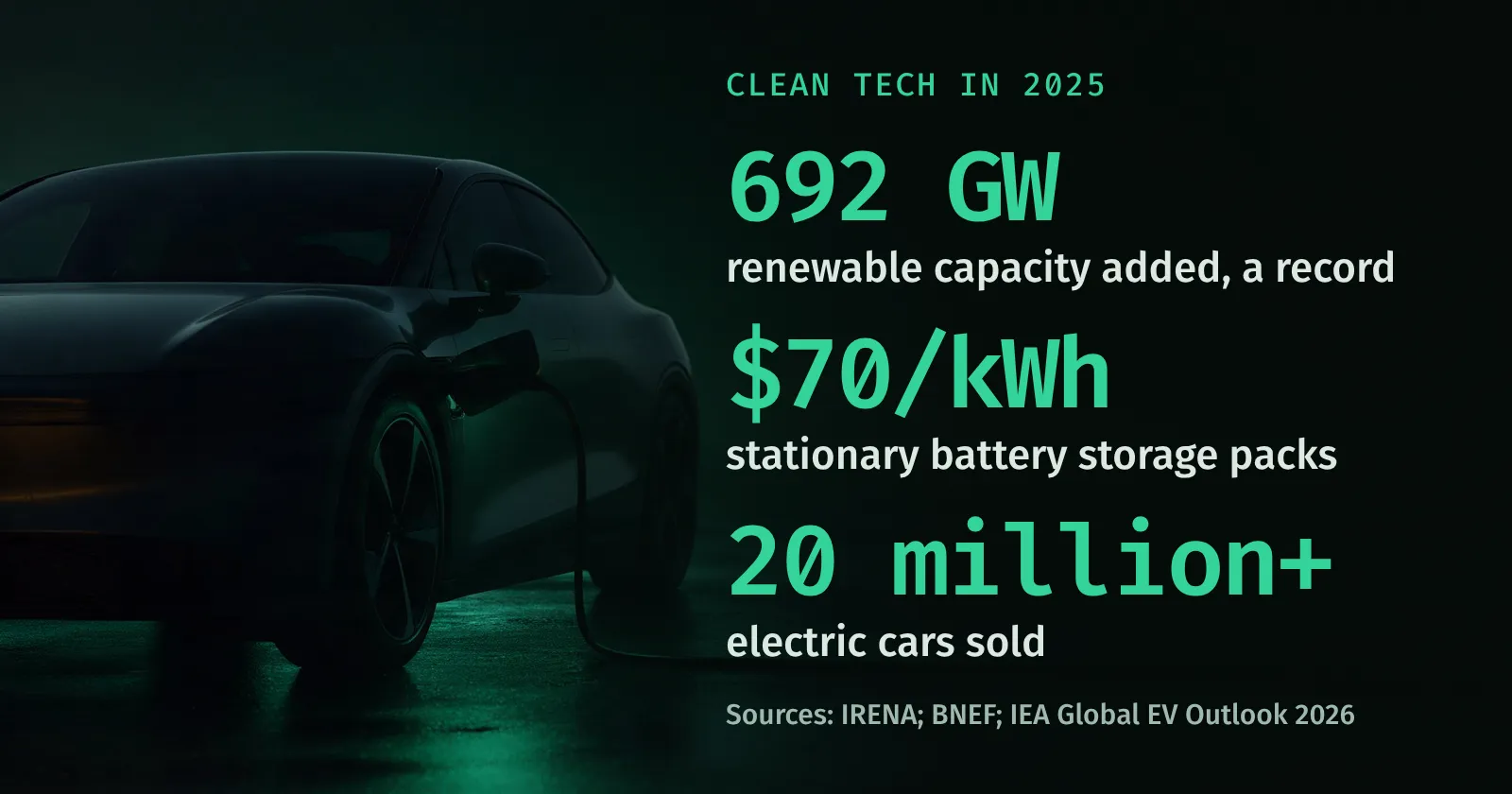
IRENA counted a record 692 GW of new renewable power capacity in 2025, taking the global total to about 5,150 GW. Solar accounted for about 511 GW, roughly three-quarters of the additions, up from 452 GW in 2024. Renewables made up about 86% of all new power capacity.
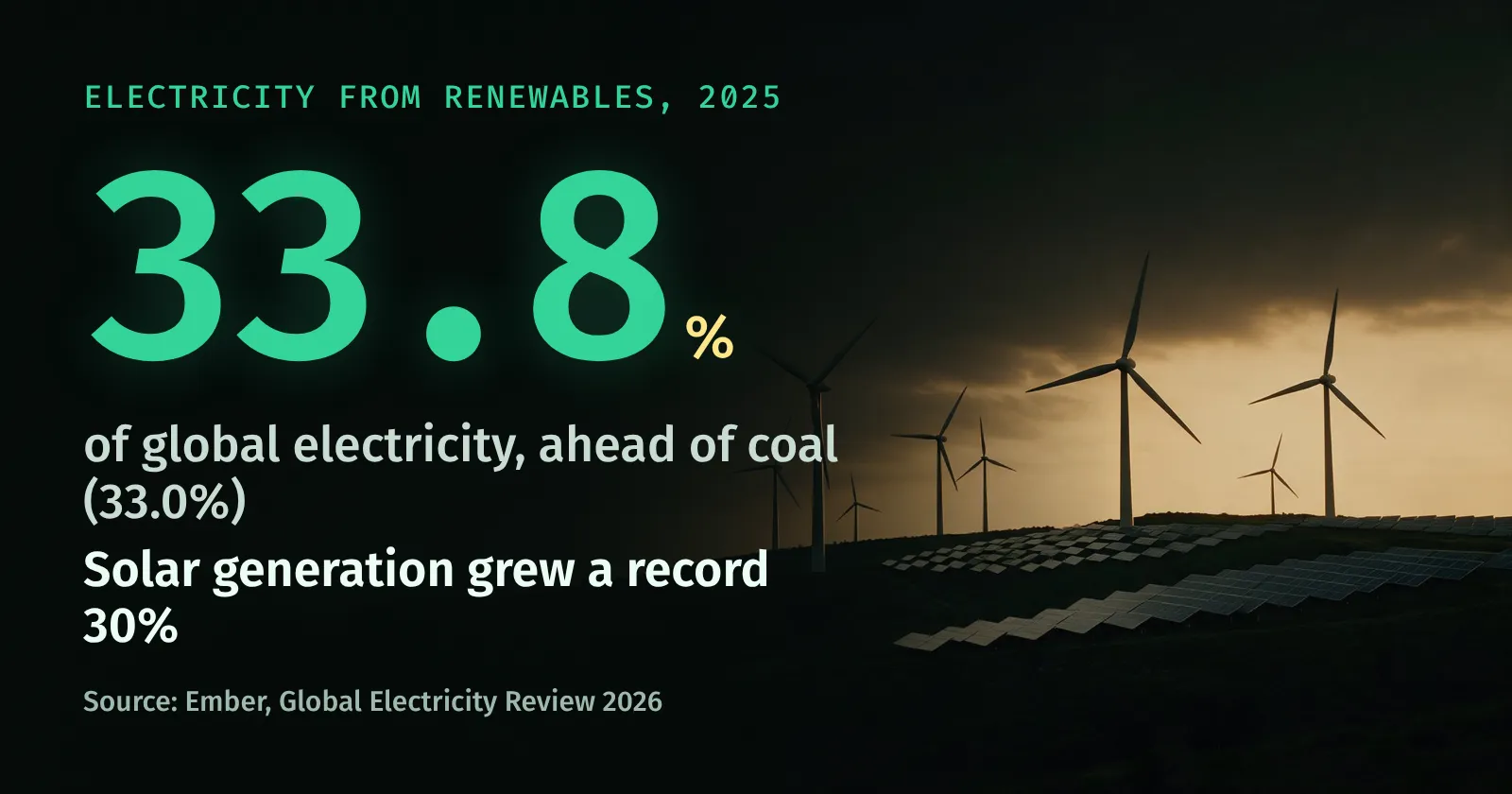
Ember’s Global Electricity Review 2026 found that solar generation grew by a record 636 TWh in 2025 and met about three-quarters of the rise in global electricity demand. Renewables supplied 33.8% of the world’s electricity against 33.0% for coal, and fossil generation fell slightly (−0.2%), the first year without an increase since 2020.
On cost, IRENA found that 91% of new utility-scale renewable projects commissioned in 2024 produced power more cheaply than the cheapest new fossil fuel alternative. The global average cost was $0.034/kWh for onshore wind and $0.043/kWh for solar PV. Much of the manufacturing, from polysilicon to modules, happens in China, which is also the largest installer.
The constraint now is less about cost than about grids, permitting and storage. For what this means for households, see our renewable energy guide for 2026.
Batteries and storage: prices keep falling
BloombergNEF’s 2025 battery price survey put the average lithium-ion pack at $108/kWh, about 8% lower than in 2024 despite higher metal prices. Packs for stationary storage fell to $70/kWh, roughly 45% lower in a year, making grid storage the cheapest battery segment for the first time. Lithium iron phosphate (LFP) packs averaged $81/kWh.
Cheap storage lets solar power cover evening demand and reduces the need for gas plants that only run at peak times. Newer chemistries such as sodium-ion and iron-air batteries are entering early deployment, but lithium-ion remains dominant, and claims of storage at “$20/kWh” refer to long-term targets, not today’s prices.
Electric cars and heat pumps: electrifying everyday energy
More than 20 million electric cars were sold in 2025, about a quarter of new cars worldwide, according to the IEA’s Global EV Outlook 2026. China sold more than 13 million and electric cars reached nearly 55% of its market; Europe sold 4.2 million (28%), while the United States stayed just under 10%. In the first half of 2026 the global share was 24%, and the IEA expects about 29% for the full year. Our transport emissions guide compares EV and petrol car lifecycle emissions.
Heat pumps move heat rather than burning fuel. A typical household unit delivers about four units of heat per unit of electricity, which makes it three to five times more efficient than a gas boiler, according to the IEA. Sales have stalled since 2022, falling about 1% globally in 2024 and 2% in 2025, but European sales rose 11% in 2025, the first growth there since 2022. See how to save energy at home for whether a heat pump suits your house.
Green hydrogen: useful, but expensive and slow
Hydrogen made with renewable electricity could cut emissions in steelmaking, fertiliser, refining and possibly shipping fuels. But it is still far more expensive than hydrogen made from natural gas. BloombergNEF estimates green hydrogen at about $3.74–11.70 per kg, against $1.11–2.35 for grey hydrogen, and in late 2024 it said green hydrogen may not reach cost parity with grey hydrogen even by 2050.
The IEA’s Global Hydrogen Review 2025 found low-emissions hydrogen production grew 10% in 2024 and is on track for about 1 Mt in 2025, still less than 1% of global hydrogen production. Projects that are operating or have reached a final investment decision would lift that to about 4.2 Mt a year by 2030, around 4% of production.
Direct air capture: what it really costs
Direct air capture (DAC) uses fans and chemical filters to pull CO₂ out of ordinary air so it can be stored underground. It is one of the few ways to permanently remove CO₂ already emitted, but it is energy-hungry and expensive because CO₂ in ordinary air is very dilute.
- Scale today: the IEA counts 27 DAC plants commissioned worldwide, capturing almost 0.01 Mt of CO₂ a year in total. All are small, and most are for testing and demonstration.
- Largest plants: Climeworks’ Mammoth plant in Iceland is designed for up to 36,000 tonnes a year but has operated well below that in its first years. The 500,000-tonne Stratos plant in Texas, built by Occidental’s 1PointFive, is built, but its start-up was delayed in 2026 by a problem with non-process equipment.
- Cost: Climeworks’ chief executive said in 2024 that costs were “closer to the $1,000/ton mark than we are to the $100/ton mark”. The company aims for $400–600 per tonne of net removal by 2030.
- Needed: the IEA’s net zero pathway calls for around 70 Mt a year by 2030, about 7,000 times today’s capacity.
For scale, removing just one year of today’s emissions (about 42 billion tonnes) at $1,000 per tonne would cost around $42 trillion, which is why cutting emissions remains far cheaper than removing them later.
Carbon capture and storage: proven, but well behind schedule
Carbon capture and storage (CCS) captures CO₂ from power plants and industry, such as cement, ammonia and gas processing, and injects it underground. The technology is proven, but deployment has been slow and many early projects underperformed.
The Global CCS Institute’s 2025 report counted 77 operating commercial facilities with about 64 million tonnes a year of capture capacity, up 25% in a year, with 44 Mt more under construction. Its 2026 report counts 113 operating projects and expects capacity to pass 100 Mt a year once those under construction start up. More than 400 Mt of CO₂ has been stored since 1996.
For comparison, the IEA’s net zero roadmap has about 1 billion tonnes captured and stored each year by 2030. Current capacity is well under a tenth of that, and today’s total is about 0.15% of global CO₂ emissions.
Nuclear and small modular reactors: where things stand
Small modular reactors (SMRs) promise factory-built units of up to about 300 MW that are quicker to build than large plants. In 2026 they are moving from paper to concrete, but none are yet operating commercially in Europe or North America.
- Canada: Ontario Power Generation received a construction licence in April 2025 for the first of four GE Vernova Hitachi BWRX-300 units at Darlington, totalling 1,200 MW. The first unit is targeted for end-2030.
- United States: the Nuclear Regulatory Commission issued a construction permit for TVA’s 300 MW Clinch River SMR on 29 September 2026. TVA has not yet announced when construction will start.
- China: the 125 MW Linglong One on Hainan completed its main pre-operation tests in 2025 and was scheduled to start commercial operation in 2026.
First-of-a-kind SMRs are expensive, and claims that they already compete with renewables plus storage on cost are not yet supported by delivered projects. Their value will depend on whether later units come in cheaper and faster. Nuclear policy and emissions trends differ widely by country; compare the United States with France.
How much money is flowing into clean energy?
The IEA’s World Energy Investment 2026 expects global energy investment of about $3.4 trillion this year, up 5% in real terms. Of that, about $2.2 trillion goes to clean energy, covering renewables, nuclear, grids, storage, low-emissions fuels, efficiency and electrification, roughly double the $1.2 trillion invested in fossil fuels. Grid investment is expected to approach $550 billion.
That is a large sum, but most of it goes to established technologies, not to breakthrough ideas. Investment and emissions are also concentrated in a few countries; see the CO₂ emissions by country ranking.
How to read climate tech headlines
- Ask whether a cost is achieved today or a target for 2030 or later.
- Compare stated “capacity” with tonnes actually captured or energy actually delivered.
- Check scale: a plant capturing thousands of tonnes a year is small next to the 42 billion tonnes the world emits.
- Prefer data from the IEA, IRENA, Ember, BNEF and the Global CCS Institute over company press releases.
- Remember that the cheapest tonne of CO₂ is usually the one never emitted.
Questions and answers
How much does direct air capture cost per tonne in 2026?
Real-world costs are still several hundred to around $1,000 per tonne of CO₂. Climeworks’ chief executive said in 2024 that its costs were “closer to the $1,000/ton mark than … the $100/ton mark”, and the company targets $400–600 per tonne of net removal by 2030. No plant has demonstrated $100 per tonne.
Which climate technologies are actually working at scale?
Solar power, onshore and offshore wind, lithium-ion batteries, electric cars and heat pumps are mature, commercially competitive and being deployed at hundreds of gigawatts or tens of millions of units a year. Most emission cuts this decade will come from these.
Is green hydrogen cheaper than fossil hydrogen yet?
No. BloombergNEF estimates green hydrogen at about $3.74–11.70 per kg against $1.11–2.35 for grey hydrogen made from natural gas. Low-emissions hydrogen makes up less than 1% of global hydrogen production, according to the IEA.
Are small modular reactors operating yet?
Not at commercial scale in the West. Construction of the first BWRX-300 unit started at Darlington, Canada in 2025 with a target of end-2030, and the US NRC issued a construction permit for TVA’s Clinch River SMR in September 2026. China’s 125 MW Linglong One was scheduled to begin commercial operation in 2026.
How much is being invested in clean energy?
The IEA expects total global energy investment of about $3.4 trillion in 2026, of which about $2.2 trillion goes to clean energy (renewables, nuclear, grids, storage, efficiency and electrification), roughly double fossil fuel investment.
Sources
- Global Electricity Review 2026, Ember, 2026
- Renewable Capacity Statistics 2026 highlights, IRENA, 2026
- Renewable Power Generation Costs in 2024, IRENA, 2025
- Lithium-ion battery pack prices fall to $108/kWh (BNEF Battery Price Survey 2025), Energy-Storage.News, 2025
- BloombergNEF: battery pack prices hit new low in 2025, TaiyangNews, 2025
- Global EV Outlook 2026: Trends in electric cars, IEA, 2026
- Electric Car Markets in a Time of Uncertainty, IEA, 2026
- Global Energy Review 2026: Heat pumps, IEA, 2026
- The Future of Heat Pumps: How a heat pump works, IEA, 2022
- Global Hydrogen Review 2025, IEA, 2025
- Green hydrogen costs set to stay too high for too long (BNEF levelized cost of hydrogen), Hydrogen Central, 2024
- Direct Air Capture, IEA
- Unlocking the potential of direct air capture: is scaling up through carbon markets possible?, IEA
- Mammoth direct air capture and storage facility, Climeworks
- DAC developers take on cost challenge, Energy Intelligence, 2024
- Global Status of CCS 2025, Global CCS Institute, 2025
- Global operating CCS capacity to surpass 100 Mtpa (Global Status of CCS 2026), Carbon Herald, 2026
- Net Zero Roadmap: CCUS, IEA, 2023
- NRC issues first US construction permit for BWRX-300 at TVA Clinch River, GE Vernova, 2026
- North American construction is back at OPG’s Darlington, American Nuclear Society, 2026
- World Energy Investment 2026, IEA, 2026
- Global Carbon Budget 2025, Global Carbon Project