Home energy
How to save energy at home: 15 changes that cut bills and CO₂, ranked by impact
Heating, cooling and hot water use most of the energy in a typical home, so that is where the biggest savings are. Here is what to change first, what it costs and roughly what it saves.
The short answer: heat, hot water, then electricity
The fastest way to save energy at home is to tackle heating and cooling first, hot water second and electrical appliances third, because that is the order in which homes use energy. In the US, space heating and air conditioning take about 52% of household energy and water heating roughly 17%. In colder countries heating’s share is higher still.
That means the cheapest big win is usually your thermostat, followed by draught-proofing and insulation, then a heat pump when your boiler or furnace is due for replacement. LED bulbs and switching off standby loads are worth doing, but they are smaller. The ranked list below gives typical savings from the US Department of Energy (DOE), the International Energy Agency (IEA), ENERGY STAR and the UK Energy Saving Trust (EST).
How the savings in this guide are calculated
Real savings depend on your climate, home, fuel and prices, so treat the numbers here as a guide to scale rather than a promise. To make them comparable, the table uses two simple reference cases:
- Heating: an illustrative gas-heated home burning 12,000 kWh of gas a year for space heating. Gas emits about 0.18 kg CO₂e per kWh (UK DESNZ conversion factors), so that is about 2.2 tonnes of CO₂ a year.
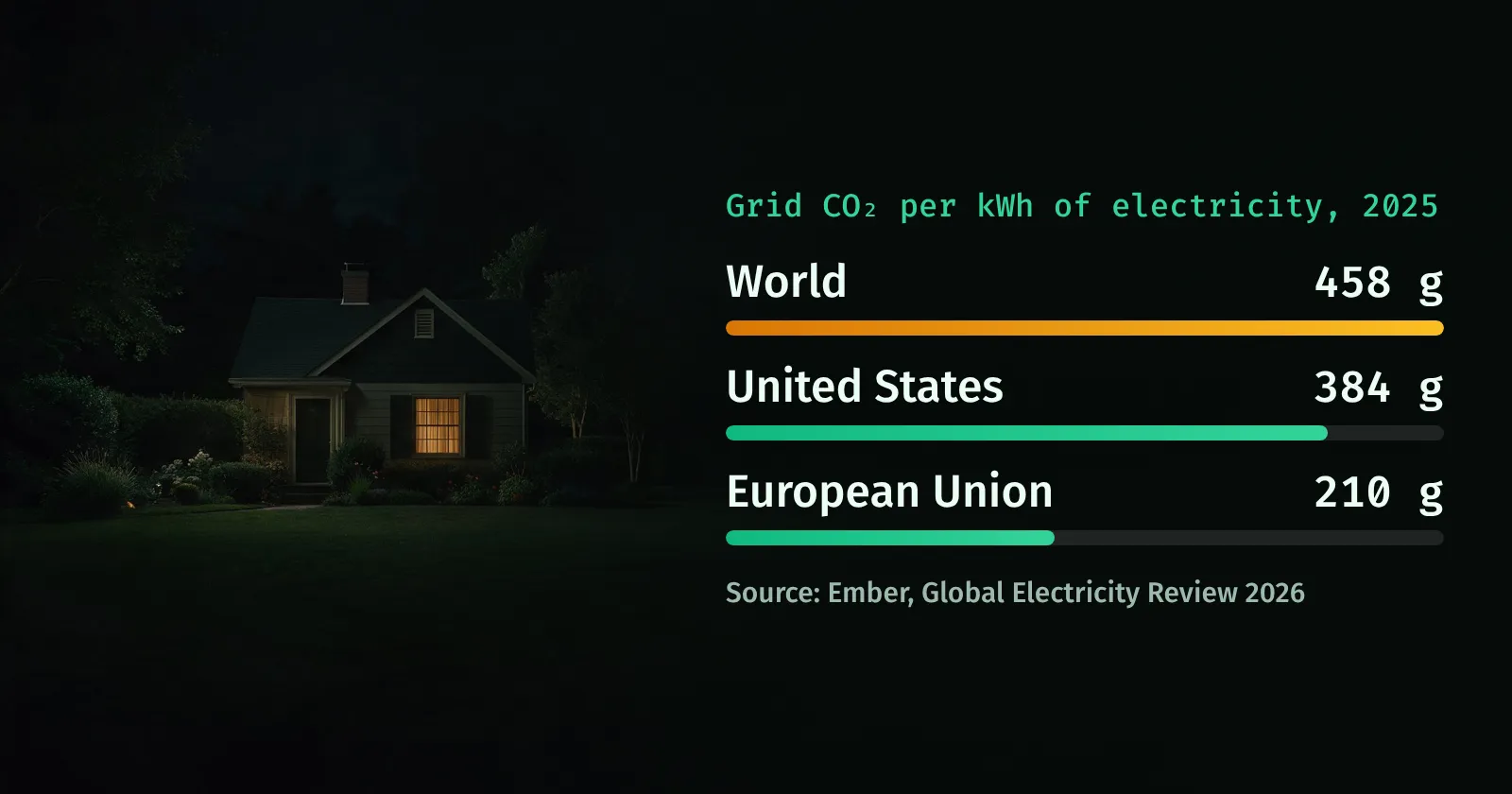
- Electricity: the 2025 world-average grid intensity of 458 g CO₂ per kWh (Ember). Your grid may be much cleaner or dirtier: about 210 g in the EU, 384 g in the US, 525 g in China and 670 g in India. Money examples use the US average residential price of roughly 18 cents per kWh (EIA, late 2025).
You can compare how clean the power is where you live on our CO₂ emissions by country ranking.
15 energy-saving changes ranked by impact
| Action | Upfront cost | Typical yearly saving | Example CO₂ saved (kg/yr) |
|---|---|---|---|
| 1. Replace gas boiler with a heat pump | High (grants in some countries) | At least 20% of heating CO₂, up to ~80% on clean grids | 550-1,440 |
| 2. Air seal and insulate loft/attic | Low to medium | ~15% of heating and cooling energy | ~330 |
| 3. Heat pump water heater (replacing electric) | Medium | Uses 1/2 to 1/3 of the electricity | 690-920 |
| 4. Night and away setbacks | Free to low | Up to 10% of heating and cooling costs | up to ~220 |
| 5. Lower boiler flow temperature | Free | Up to 8% of heating and hot-water energy | up to ~175 |
| 6. Thermostat down 1 °C | Free | ~7% of heating energy | ~150 |
| 7. Cut always-on (idle) load by 50 W | Free to low | ~440 kWh, ~$80 | ~200 |
| 8. Swap 10 incandescent bulbs for LEDs | Low | ~560 kWh, ~$100 | ~260 |
| 9. Draught-proof windows and doors | Low | ~£55 a year in Great Britain (EST) | part of #2 |
| 10. Four-minute showers | Free | ~£45 a year in Great Britain (EST) | varies |
| 11. Set air conditioning 1 °C warmer | Free | ~10% of AC electricity | ~90 |
| 12. Wash warm or cool, full loads | Free | Hot to warm halves energy per load | varies |
| 13. Air-dry laundry | Free | All dryer electricity | varies |
| 14. Buy efficient appliances when replacing | Medium | Depends on label and use | varies |
| 15. Shift flexible use to cheap, clean hours | Free | Lower bills on time-of-use tariffs | varies |
The order is roughly by CO₂ impact for a typical home that is heated by fuel. If your home is heated electrically, the heating rows matter even more, because a heat pump uses about half the electricity of resistance heaters, or less (DOE).
Heating and cooling: where most of the savings are
1. Turn the thermostat down 1 °C
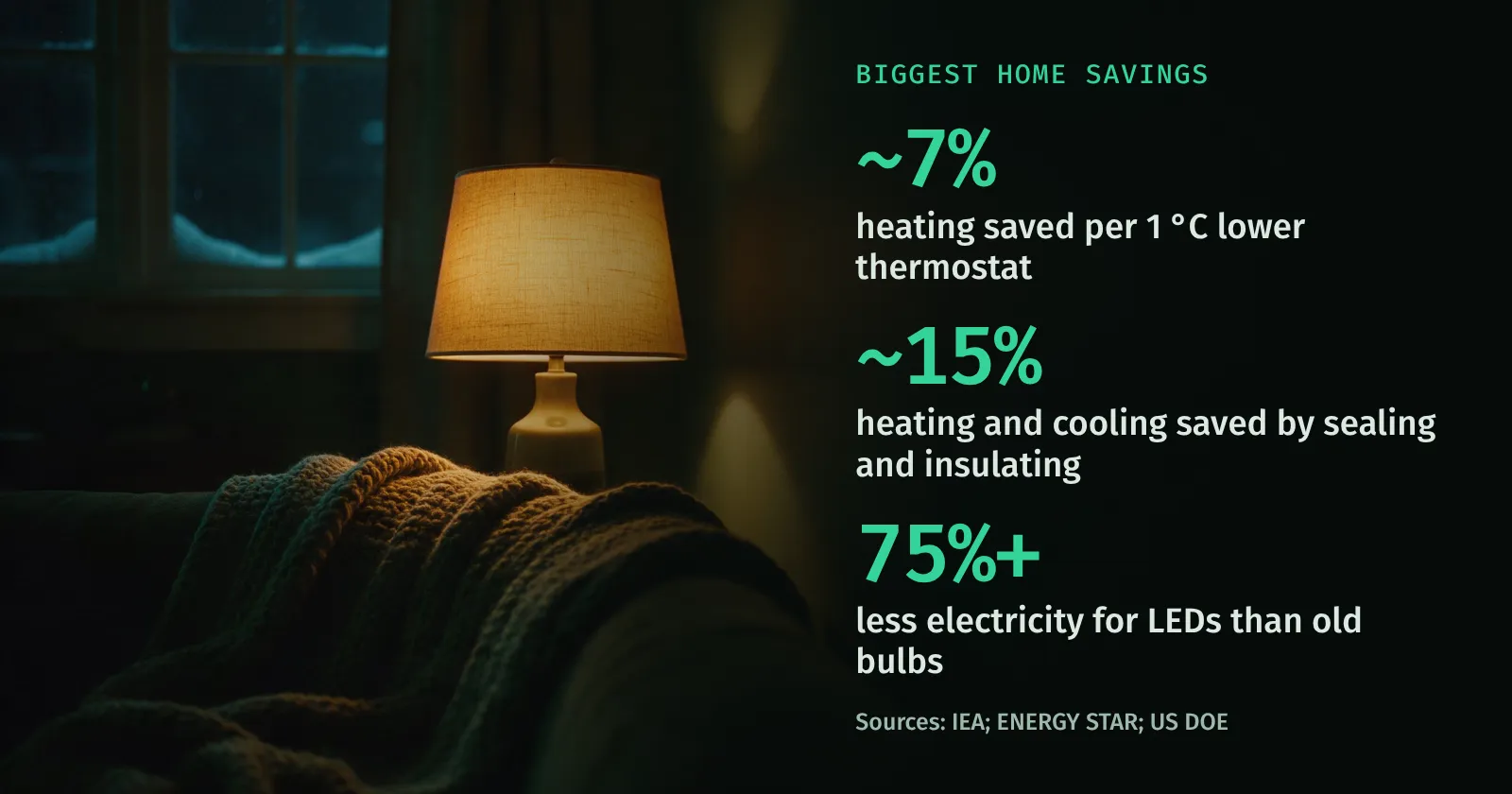
The IEA estimates that each 1 °C reduction cuts heating energy by about 7%, worth more than €70 a year for a typical EU household at 2022 prices. It also found that average indoor heating temperatures in the EU are above 22 °C, while many people are comfortable at 19-20 °C. Try one degree for a week; most people stop noticing within days.
2. Use setbacks when you are asleep or out
The DOE says setting the thermostat back 7-10 °F (about 4-5 °C) for eight hours a day can save up to 10% a year on heating and cooling. A programmable or smart thermostat does it automatically. With a heat pump, keep setbacks small, because the DOE warns that large setbacks can switch on less efficient backup heating.
3. Lower your condensing boiler’s flow temperature
Condensing gas boilers run most efficiently when the water returning to them is cool. The IEA says adjusting default boiler settings can save up to 8% of the energy used to heat rooms and water. Many boilers leave the factory set at 70-80 °C; 60 °C or lower is often enough for radiators, but check your manual or ask a heating engineer about hot-water settings.
4. Air seal, draught-proof and insulate
ENERGY STAR’s modelling of typical US homes finds that air sealing plus insulating attics, floors over crawl spaces and basement rim joists saves around 15% on heating and cooling, or 11% of total energy costs. In the UK, the EST estimates that professional draught-proofing of windows and doors saves around £55 a year in Great Britain, and that insulating an empty loft to 270 mm saves about £190 a year for a gas-heated semi-detached house.
- Feel for draughts around window frames, doors, letterboxes, loft hatches and skirting boards on a windy day.
- Seal gaps with self-adhesive strips, brush strips and silicone; fit a chimney balloon or cap on unused chimneys.
- Check loft or attic insulation depth; if you can see the tops of the joists, there is room for more.
- Ask about cavity or solid-wall insulation if your walls are uninsulated, and look for local grants first.
- Keep trickle vents and extractor fans working: you want to stop draughts, not ventilation.
5. Switch to a heat pump when your boiler is due
Heat pumps move heat rather than burn fuel, so they deliver three to five times more heat per unit of energy than a boiler. The IEA finds they cut emissions by at least 20% compared with a gas boiler even on emissions-intensive grids, and by up to about 80% on cleaner grids.
In our reference home, a heat pump with a conservative seasonal efficiency of 3 replacing a 90%-efficient boiler would use about 3,600 kWh of electricity a year. On the world-average grid that saves about 550 kg CO₂ a year (25%); on an EU-average grid it saves about 1,440 kg (66%). Running costs depend on your gas-to-electricity price ratio, so ask installers for an estimate based on your own bills and check for grants such as the UK’s £7,500 Boiler Upgrade Scheme.
6. Keep cooling efficient
The IEA estimates that setting air conditioning 1 °C warmer cuts its electricity use by almost 10%. Shading windows from direct sun, using fans and closing curtains in the day all reduce how hard the AC has to work. For a home whose AC uses 2,000 kWh a year, 1 °C warmer saves about 200 kWh and 90 kg CO₂ at world-average grid intensity.
Hot water: the second-biggest energy use
Water heating is about 17% of energy use in the average US home, according to the DOE. Three changes make the most difference:
- Shorter showers. The EST estimates that keeping showers to four minutes saves a household about £45 a year in Great Britain and around 17,000 litres of water. A water-efficient shower head helps, but check it suits your boiler or electric shower.
- Cooler laundry. Most of a washing machine’s energy goes on heating water. The DOE says switching from hot to warm cuts the energy per load roughly in half, and cold washes save more. Modern detergents clean well at 30 °C.
- A heat pump water heater. When an electric water heater needs replacing, the DOE says a heat pump model can be two to three times more efficient. If a resistance tank uses 3,000 kWh a year, a heat pump version would save roughly 1,500-2,000 kWh, or 690-920 kg CO₂ at world-average intensity.
Also insulate hot-water tanks and the first metre or so of pipe, and fix dripping hot taps.
Electricity: lighting, standby and appliances
7. Hunt down always-on loads
The DOE says standby power accounts for 5-10% of residential energy use and can cost a household up to about $100 a year. An NRDC study of 70,000 northern California homes found that always-on load from inactive devices averaged about 23% of household electricity. Cutting just 50 W of constant draw saves about 440 kWh a year, which is roughly $80 and 200 kg CO₂ at the reference values.
- Read your meter late at night when everything is off; the number left is your baseload (our guide to tracking home energy use shows how).
- Use a plug-in power meter on TVs, games consoles, set-top boxes, speakers and desktop computers.
- Put the entertainment corner on a switched strip or smart plug that turns off overnight.
- Turn off console “instant-on” or “quick start” modes and old second fridges or freezers you do not need.
8. Switch to LED lighting
The DOE says good-quality LEDs use at least 75% less energy than incandescent bulbs and last up to 25 times longer. Replacing ten 60 W bulbs with 9 W LEDs that are each on for three hours a day saves about 560 kWh a year, which is around $100 and 260 kg CO₂ at the reference values. If you already use LEDs throughout, this one is done.
9. Use appliances smartly and replace wisely
- Laundry: wash full loads, air-dry when you can and clean the dryer filter.
- Kitchen: boil only the water you need, keep lids on pans and run the dishwasher full on eco mode.
- Fridges and freezers: leave space around the back for airflow and defrost manual freezers when ice builds up.
- Replacing: choose the most efficient label you can afford and the right size for your household; a bigger appliance usually uses more.
10. Shift flexible use to cheaper, cleaner hours
Shifting the dishwasher, laundry or electric-car charging does not reduce how many kWh you use, but on a time-of-use tariff it lowers bills, and it often moves demand to hours when the grid is running on more wind or solar.
Where to start this week
If you want a simple plan, do the free things now, the cheap things this month and the big things when equipment is due for replacement:
- Today: turn the heating down 1 °C, set a night setback and lower the boiler flow temperature if you have a condensing boiler.
- This week: read your meter to find your baseload, then switch off the biggest idle loads.
- This month: draught-proof doors and windows, swap your most-used bulbs to LED and wash at 30 °C.
- This year: get quotes for loft or wall insulation and check grants in your country.
- When the boiler or water heater is due: get a heat pump quote before you replace like for like.
To see how these savings fit into your whole footprint, including travel and food, use our carbon footprint calculator guide. If you are thinking about solar panels or a green tariff as the next step, see renewable energy in 2026.
Why household savings still matter
The world emitted about 42.2 billion tonnes of CO₂ in 2025, roughly 1,338 tonnes every second, as you can watch on the live CO₂ counter. One home’s savings are small against that, but homes are a large share of energy demand, and cutting waste now also makes it cheaper to run a house on clean electricity later. A well-insulated home with a heat pump and efficient appliances needs a smaller heat pump, a smaller solar system and less grid power.
Questions and answers
What uses the most energy in a home?
Heating. In the US, space heating and air conditioning together account for about 52% of household energy use and water heating for roughly 17%. In cold climates heating’s share is higher, so insulation, draught-proofing and thermostat settings come before anything else.
How much can I save by turning my thermostat down 1 °C?
The IEA estimates that turning the heating down by 1 °C cuts heating energy by about 7%, which it put at more than €70 a year for a typical EU household at 2022 prices. Your saving depends on your fuel price, climate and how well insulated your home is.
Is it cheaper to leave the heating on low all day?
Usually not. A home loses heat faster the warmer it is inside, so letting it cool while you sleep or are out saves energy. The US Department of Energy says a 7-10 °F (4-5 °C) setback for eight hours a day can cut heating and cooling costs by up to 10% a year. Heat pumps are the exception: keep setbacks small, because large ones can trigger less efficient backup heating.
Does unplugging appliances really save money?
It can. The US Department of Energy says standby power accounts for 5-10% of residential energy use and can cost a household up to about $100 a year. Measure first with a plug-in meter, then switch off the worst offenders at the wall or with a smart power strip.
What is the single biggest energy saving for a gas-heated home?
If your home is already reasonably insulated, replacing the gas boiler with a heat pump usually cuts heating emissions the most. Heat pumps are three to five times more efficient than boilers, and the IEA finds they cut emissions by at least 20% even on fossil-heavy grids. For poorly insulated homes, insulation and draught-proofing come first.
Sources
- Use of energy explained: energy use in homes, US Energy Information Administration, 2023
- Heat pump water heaters (water heating ~17% of home energy use), US Department of Energy
- Playing my part: how to save money and reduce reliance on Russian energy, IEA, 2022
- Programmable thermostats, US DOE Energy Saver
- Seal and insulate: methodology for estimated energy savings, ENERGY STAR (US EPA)
- Quick tips to save energy, Energy Saving Trust, 2026
- Loft insulation costs and savings (Energy Saving Trust figures), Which?, 2026
- The Future of Heat Pumps, IEA, 2022
- Apply for the Boiler Upgrade Scheme, GOV.UK
- Electric resistance heating, US DOE Energy Saver
- LED lighting, US DOE Energy Saver
- Are energy vampires sucking you dry? (standby power), US DOE Energy Saver
- Home idle load: devices wasting huge amounts of electricity when not in active use, NRDC, 2015
- Laundry, US DOE Energy Saver
- Global Electricity Review 2026 (grid carbon intensity 2025), Ember, 2026
- Greenhouse gas reporting: conversion factors (natural gas ~0.18 kg CO₂e/kWh), UK DESNZ
- Electric Power Monthly (US residential price ~17.8 ¢/kWh, Nov 2025), US EIA, 2026