How-to
15 quick ways to reduce your carbon footprint, ranked by impact
Each of these takes about five minutes to set up. They are ranked by how much they actually save, because the gap between the best and the rest is huge.

Which quick changes cut the most carbon?
The quick changes that save the most are replacing a long-haul flight (about 1.6 t CO₂e per return trip), switching to a renewable electricity tariff (0.3–4 t a year, depending on your country) and swapping beef for other foods once a week (0.2–0.7 t). Each takes a few minutes to set up.
Most familiar tips, like unplugging chargers or washing at 30 °C, save between 10 and 100 kg a year. They are still worth doing, especially for your bills, but one avoided long-haul flight saves more than tips 5 to 15 below put together. The table ranks all 15 by typical annual saving.
| # | Change (about 5 minutes to set up) | kg CO₂e saved a year |
|---|---|---|
| 1 | Replace one long-haul return flight | 1,600 |
| 2 | Switch to a renewable electricity tariff (household) | 300–4,000 |
| 3 | Swap one beef meal a week for chicken or beans | 200–700 |
| 4 | Take the train instead of one short-haul return flight | up to 300 |
| 5 | Lower a combi boiler’s flow temperature to 60 °C (household) | 200 |
| 6 | Drive more smoothly | 200 |
| 7 | Turn the thermostat down 1 °C (household) | 150 |
| 8 | Leave the car at home one commute day a week | 150 |
| 9 | Eat 100 g less cheese a week | 120 |
| 10 | Plan meals to halve food waste | 120 |
| 11 | Walk or cycle 10 km of short car trips a week | 85 |
| 12 | Line-dry instead of tumble-drying (household) | 30–100 |
| 13 | Switch devices off standby (household) | 20–70 |
| 14 | Check your tyre pressure monthly | 20–40 |
| 15 | Wash clothes at 30 °C (household) | 11 |
The four quick changes that matter most
1. Replace one long-haul return flight
What to do: before you book next year’s holiday, choose one destination you can reach by train, or combine two long trips into one longer stay.
Saving: about 1.6 t CO₂e per economy return trip of around 7,000 km each way, using the UK government’s 2025 factor of 0.117 kg CO₂e per passenger-km including the extra warming from contrails. A 2020 review of 53 studies put the median saving from one fewer long return flight at more than 1.7 t.
Honest note: this is the largest one-off decision most people make each year. Premium cabins have far higher per-passenger emissions, so if you do fly, economy matters.
2. Switch to a renewable electricity tariff
What to do: compare tariffs online and switch; it takes a few minutes and usually needs only a meter reading.
Saving: it depends on your grid and use. A typical UK home uses 2,700 kWh a year at about 126 g CO₂ per kWh, which is about 0.34 t. A typical US home uses about 10,400 kWh at 384 g per kWh, which is about 4 t. The 2020 review found a median saving of 1.6 t per person.
Honest note: not all green tariffs are equal. Ones that buy directly from renewable generators or fund new capacity do more than those that only buy certificates. Rooftop solar or a community energy scheme are stronger options if they are open to you.
3. Swap one beef meal a week for chicken or beans
What to do: pick one regular beef dish, such as a weekly chilli or burger night, and switch it to chicken, beans or lentils. Add it to your shopping list now.
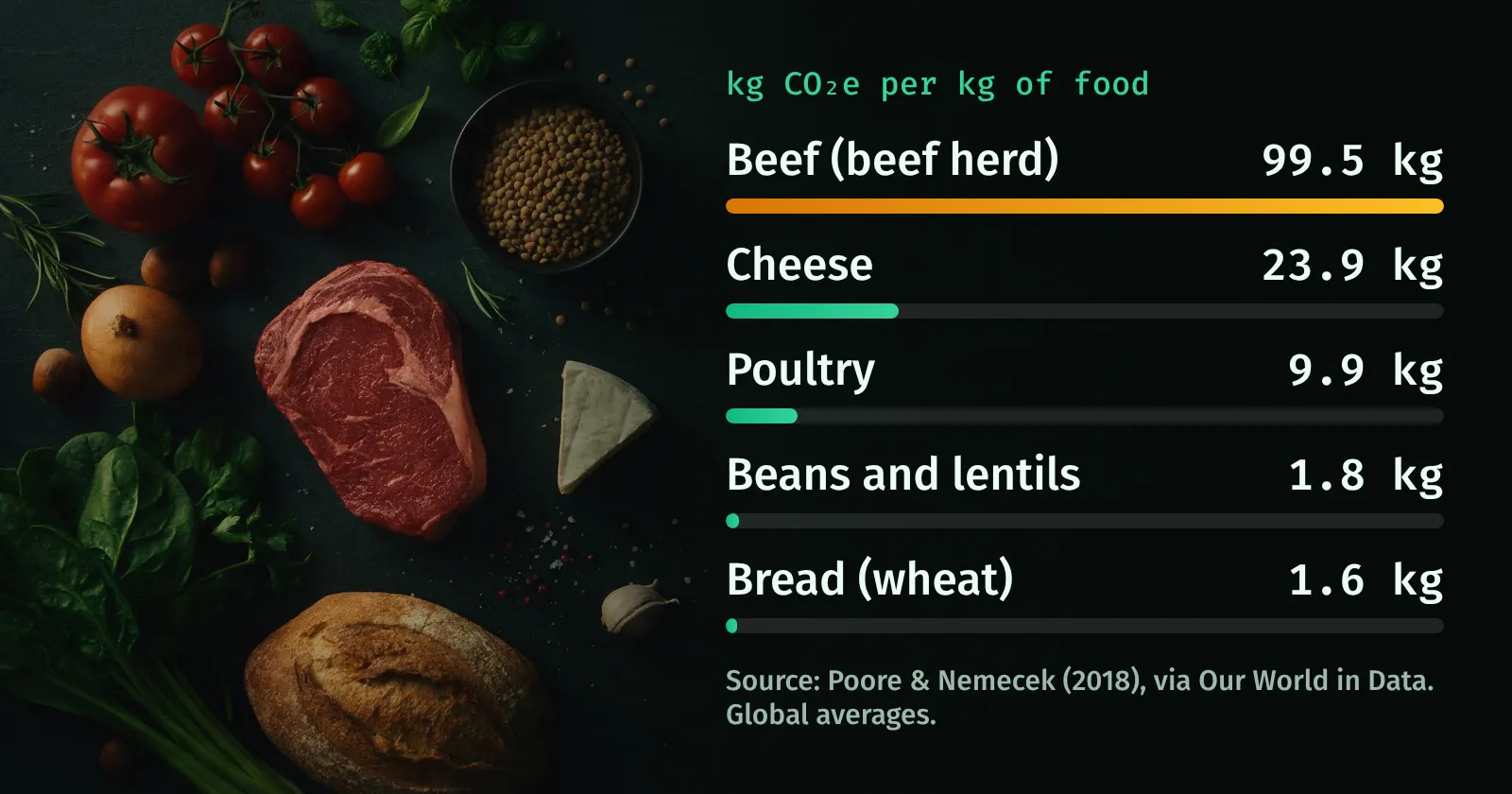
Saving: a 150 g portion once a week is 7.8 kg of beef a year. Using Poore and Nemecek’s global averages, beef from beef herds emits 99.5 kg CO₂e per kg and chicken 9.9 kg, so the swap saves about 0.7 t. Beef from dairy herds (33.3 kg per kg) gives a smaller saving of about 0.2 t.
Honest note: lamb (39.7 kg CO₂e per kg) is the next biggest lever. Going fully plant-based saves about 0.8 t a year, according to the same research reviews.
4. Take the train instead of one short-haul return flight
What to do: for trips under about 1,000 km, check the rail option before you book a flight. Overnight trains can save a hotel night too.
Saving: an economy return flight of 1,200 km each way emits about 0.3 t CO₂e at the UK government’s 2025 short-haul factor of 0.126 kg per passenger-km. Rail emits a small fraction of that, so most of the 0.3 t is saved.
Honest note: domestic flights have even higher emissions per kilometre, because take-off uses a large share of the fuel on short routes.
Worth doing: about 0.1–0.2 tonnes a year each
5. Lower your combi boiler’s flow temperature to 60 °C
What to do: on a condensing combi boiler, turn the radiator (central heating) dial down to 60 °C. Nesta’s step-by-step guide covers most models.
Saving: Nesta estimates about 9% of gas use when turning down from 80 °C. For a home using 12,000 kWh of gas, that is 1,092 kWh, or about 0.2 t CO₂e at 0.183 kg per kWh.
Honest note: rooms may take a little longer to warm up. If your home has a hot water cylinder, keep the cylinder at a safe temperature as the manufacturer advises.
6. Drive more smoothly
What to do: accelerate gently, keep to the speed limit and look ahead to avoid hard braking. If your car shows live fuel use, turn that display on.
Saving: US government tests found aggressive driving lowers fuel economy by roughly 15–30% at highway speeds and 10–40% in stop-and-go traffic. If calmer driving trims 10% off 12,000 km a year in an average petrol car (0.163 kg CO₂e per km), that is about 0.2 t.
Honest note: the saving is real only if you currently drive hard. It is no substitute for driving less or switching to an electric car.
7. Turn the thermostat down 1 °C
What to do: lower your thermostat by one degree and set the heating to switch off 30 minutes before you leave or go to bed.
Saving: the IEA estimates each 1 °C saves about 7% of heating energy, worth €50–70 a year on an average bill. For a typical UK home using 11,500 kWh of gas, that is about 800 kWh, or about 0.15 t CO₂e.
Honest note: keep living rooms comfortable, especially for older people, babies or anyone unwell. Turning down heating in unused rooms has a similar effect.
8. Leave the car at home one commute day a week
What to do: agree one regular home-working or public-transport day and put it in your calendar.
Saving: a 20 km round trip, 46 weeks a year, is 920 km. In an average petrol car that is about 0.15 t CO₂e.
Honest note: working from home can add heating in winter, so the net saving is smaller if you heat the whole house just for yourself.
9. Eat 100 g less cheese a week
What to do: buy a smaller block, or swap cheese in one regular meal for beans, hummus or vegetables.
Saving: cheese averages 23.9 kg CO₂e per kg in Poore and Nemecek’s data. Cutting 5.2 kg a year saves about 0.12 t, minus a little for whatever replaces it.
10. Plan meals to halve your food waste
What to do: spend five minutes planning the week’s meals before you shop, and check the fridge first.
Saving: WRAP estimates UK household food waste in 2022 at about 6 million tonnes, linked to 16 million tonnes of CO₂e. Spread across about 69 million people, that is roughly 0.23 t each, so halving it saves about 0.12 t per person.
Small but free: under 0.1 tonnes a year each
11. Walk or cycle short car trips
What to do: pick two or three regular trips under 3 km, such as the school run or a local shop, and do them on foot or by bike.
Saving: replacing 10 km of driving a week (520 km a year) in a petrol car saves about 85 kg CO₂e.
12. Line-dry instead of tumble-drying
What to do: put up an airer or washing line where it is easy to use.
Saving: the Energy Saving Trust estimates about £60 a year. At the late-2025 UK price cap of 26.35p per kWh, that is about 230 kWh, or roughly 30 kg CO₂ on the UK grid and about 100 kg on the world-average grid.
13. Switch devices off standby
What to do: plug your TV, console and speakers into one power strip and switch it off at night. Most devices keep their settings.
Saving: the Energy Saving Trust puts it at about £40 a year. That is about 150 kWh, or roughly 20 kg CO₂ in the UK and 70 kg on the world-average grid.
Honest note: the old version of this article called standby the “biggest impact” hack. It isn’t: one long-haul flight emits more than 20 years of standby savings.
14. Check your tyre pressure monthly
What to do: set a monthly phone reminder and check the pressures at a fuel station against the figures in your door frame.
Saving: fueleconomy.gov says under-inflated tyres cut fuel economy by about 0.2% for every 1 psi drop across all four tyres. Being 5–10 psi low costs 1–2% of fuel, which is about 20–40 kg CO₂e a year for 12,000 km in a petrol car. Correctly inflated tyres are also safer.
15. Wash clothes at 30 °C
What to do: make 30 °C your machine’s default and run full loads.
Saving: the Energy Saving Trust estimates about 11 kg CO₂ and £14 a year, as washing at the lower temperature uses around 57% less electricity.
What a five-minute tip can’t do
The biggest personal cuts take longer than five minutes. Research reviews consistently rank these at the top:
- Living car-free: about 2.4 t CO₂e a year, according to Wynes and Nicholas.
- Switching to an electric car, a heat pump and better insulation when the time comes to replace your car or boiler.
- A mostly plant-based diet: about 0.8 t a year.
- Flying less as a habit, not just once.
Quick tips are a good start because they build momentum and cut bills. But they work best alongside those bigger decisions, and alongside cleaner grids and transport that only governments and companies can deliver. The guide to saving energy at home and our guide to food and climate cover the larger steps in detail.
Scale matters here. The world emitted about 42.2 billion tonnes of CO₂ in 2025, and the remaining budget for a 50% chance of limiting warming to 1.5 °C is about 170 billion tonnes, roughly four years at current rates. You can watch that total climb on the live CO₂ emissions counter.
How to choose your first three
- Check your calendar for flights. If you have a long-haul trip planned, tip 1 outweighs everything else here.
- Look at your energy bills. If you heat with gas, tips 5 and 7 together save about 0.35 t a year. If your electricity is fossil-heavy, tip 2 is likely your biggest win.
- Pick one food swap. Tip 3 is the biggest food change most people can make in five minutes.
Then set a reminder for next year to recalculate your footprint and see what changed.
Questions and answers
What is the easiest way to reduce my carbon footprint?
The easiest change with a big effect is switching to a renewable electricity tariff, which takes a few minutes online. The single biggest quick decision is replacing one long-haul return flight with a trip closer to home, which saves about 1.6 t CO₂e.
Do small changes like unplugging devices really help?
They help a little. Switching off standby saves about £40 a year in the UK but only around 20–70 kg CO₂, depending on your grid. One long-haul flight emits more than 20 years of standby savings, so do the small things, but don’t stop there.
What reduces your carbon footprint the most?
Research reviews rank living car-free (about 2.4 t a year), avoiding long-haul flights (about 1.6–1.7 t per return trip), renewable electricity (a median of 1.6 t) and a plant-based diet (about 0.8 t) as the most effective individual changes.
How much CO₂ does turning the thermostat down 1 °C save?
The IEA estimates each 1 °C lower saves about 7% of heating energy. For a typical UK gas-heated home using 11,500 kWh a year, that is about 800 kWh and roughly 150 kg CO₂ a year.
How can I find which changes matter most for me?
Work out your own footprint first. Our carbon footprint calculator breaks your emissions down by category and suggests your three biggest wins.
Sources
- Greenhouse gas reporting: conversion factors 2025, UK Department for Energy Security and Net Zero (DESNZ), 2025
- Ivanova et al., Quantifying the potential for climate change mitigation of consumption options, Environmental Research Letters, 2020
- Wynes and Nicholas, The climate mitigation gap: education and government recommendations miss the most effective individual actions, Environmental Research Letters, 2017
- United States electricity data, Ember, 2026
- Analysis: UK renewables enjoy record year in 2025, Carbon Brief, 2026
- How much electricity does an American home use?, US Energy Information Administration
- Fuel poverty scenario modelling based on Ofgem price caps (typical domestic consumption values), Scottish Government, 2025
- Changes to energy price cap between 1 October and 31 December 2025, Ofgem, 2025
- Greenhouse gas emissions per kilogram of food product (Poore and Nemecek 2018), Our World in Data
- Money-saving boiler challenge, Nesta, 2022
- How to use less energy and cut your bills, International Energy Agency
- Driving more efficiently, US DOE and EPA, fueleconomy.gov
- Gas mileage tips, US DOE and EPA, fueleconomy.gov
- The household food waste study, WRAP, 2024
- Quick tips to save energy, Energy Saving Trust
- Home energy saving behaviours, Energy Saving Trust, 2024
- Global Carbon Budget 2025, Global Carbon Project, 2025